Seeing Clearly
I can’t read my phone without my glasses on.
At 9:30 p.m., my phone goes into sleep mode and only lets notifications from a handful of people through. My best friend knows that if she texts me after that, my responses will be almost unintelligible—because my glasses are off, and I refuse to put them back on just to read a text.
We laugh about it.
I always give the disclaimer.
She knows me well enough to translate the gibberish.
I’ve thought before about what it would be like to lose one of my senses. I always hated those kinds of icebreaker questions—the ones that ask you to consider something deeply personal and profound, then explain it in thirty seconds or less.
But I’ve been thinking about it more this week as I’ve been sitting with a story Luke tells in chapter 18, where Jesus heals a blind man.
It’s a familiar story. So familiar, in fact, that I could probably recite it from memory.
Jesus is traveling and teaching.
A blind man sitting by the road hears a commotion and asks what’s happening.
He’s told it’s Jesus of Nazareth.
Immediately, he begins shouting, begging Jesus for mercy.
People get annoyed.
They tell him to be quiet.
Jesus calls for him.
The man says he wants to see.
Jesus heals him and tells him his faith has given him new sight—and new life.
End of story.
Except… maybe it isn’t.
When Faith Becomes a Blindfold
I grew up in extremely legalistic evangelical churches—several of them, actually. I was there every time the doors were open. And yet, I’m not sure I would have recognized Jesus if he had walked into the sanctuary.
The version of Christianity I was handed didn’t help me see Jesus more clearly.
It blinded me.
It distorted who he was, what he valued, and how he loved.
It emphasized control over compassion.
Certainty over curiosity.
Behavior modification over transformation.
And I am endlessly grateful that Jesus had mercy on me—that somehow, over time, my eyes were opened and I was given new sight and new life.
But when I look around now, I see so many people who are still blinded—not by a lack of information, but by allegiance to a version of Christianity that doesn’t look like Christ at all.
And this is the hard truth I keep coming back to:
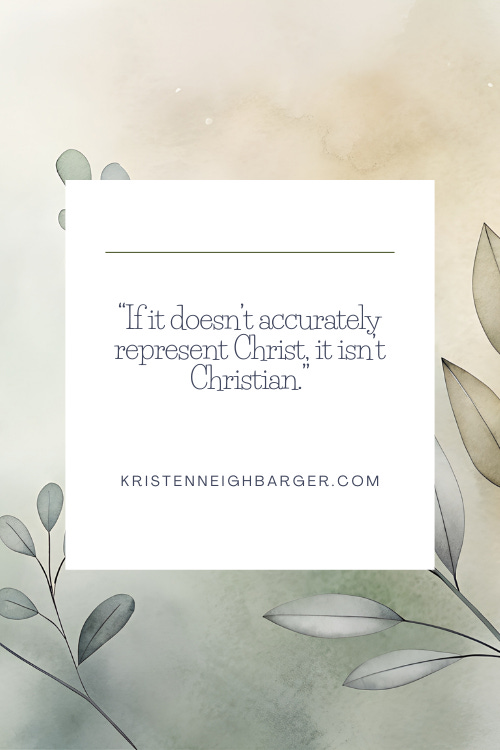
If it doesn’t accurately represent Christ, it isn’t Christian.
No matter how nicely it’s packaged.
No matter what policy it protects.
No matter how confidently it’s justified.
If it isn’t like Christ, it isn’t Christian.
Knowing About Jesus Isn’t the Same as Seeing Him
I read an article a few months ago that introduced me to the phrase “low-information voters.” And it struck me that we don’t just have low-information voters—we also have low-information Christians.
Many of us have been there ourselves.
I certainly was.
Knowing about Jesus is not the same thing as seeing him clearly—or knowing him deeply.
I grew up in the height of the WWJD movement in the ’80s and ’90s. We used that question almost exclusively as a tool for avoiding sin. What we didn’t use it for was shaping the posture of our hearts, our politics, our relationships, or our power.
But that’s where the question actually belongs.
Seeing Jesus clearly changes what we value.
Who we listen to.
Who we protect.
Which tables we sit at—and which ones we turn over.
It looks like loving the least of these.
Calling out religious leaders who hoard power.
Refusing to stay seated at tables built on harm.
Loving our neighbors as ourselves—not in theory, but in practice.
Perhaps This Is the Work Before Us
Recently, I was talking with my college-aged daughter about how what we’re witnessing right now isn’t new. It feels different because we’re living through it—but history tells us this isn’t the first time faith has been used to mask cruelty or justify control.
And maybe that’s the invitation of this moment.
Not to be louder.
Not to be cruel in return.
But to see more clearly.
To ask ourselves where our vision has been shaped more by fear than by Christ.
To let mercy open our eyes again.
To build tables where the ones Jesus loved most are not just welcomed—but centered.
Perhaps this is the work before us.
Perhaps.

Reflection Questions
Take your time with these. There’s no rush to clarity.
Where did your earliest image of Jesus come from—and who shaped it?
In what ways has your faith helped you see more clearly? In what ways has it blurred your vision?
What tables have you remained seated at that Jesus might have flipped?
Who are “the least of these” in your world right now—and what would loving them actually require?
A Gentle Invitation
If this stirred something in you—confusion, grief, resistance, or recognition—you’re not alone.
A Seat at the Table exists for these kinds of conversations: slow, honest, and rooted in seeing Jesus more clearly, not performing faith more convincingly.
You’re welcome here.
I write in two spaces. A Seat at the Table is where I explore faith, healing, and making room for honesty after it’s been made complicated. Ink & Intention is for writers who want to show up with clarity, discernment, and integrity—especially online.
I’m also the author of Breathing Again and several guided journals, and I work with writers who want thoughtful, grounded support as they find their voice and shape what comes next.
If something here resonated, you’re welcome to explore more at your own pace. You can find everything in one place here.