When Your Message and Your Media Don
I’ve been on a bit of an unfriend and unfollow spree lately.
It has nothing to do with politics, theology debates, or the news cycle—at least not directly.
I genuinely love supporting other authors. I follow their work, engage with their posts, and try to show up with encouragement—even when they invite me into a paid community approximately five minutes after accepting my friend request. (That’s a conversation for another day.)
The truth is, I’m not the target audience for a lot of the writers I follow. I’m not a homeschool mom. I’m not in the thick of early motherhood. My kid went to public school, started college at sixteen (thank you, public education), and is currently away living her best, independent life.
The same is true for authors who write about grief, addiction, suicidality, or deep trauma. I may not be their reader—but I still want to support their work and their calling.
Until the messaging no longer matches the ministry.
Over the years, I’ve watched thoughtful, grounded authors—people who show up faithfully day after da—implode their credibility with a single social media post. One reactive moment. One emotionally charged take. One post that’s misaligned with the message they’ve spent years stewarding.
And suddenly, the trust they’ve built starts to crack.
Not because they had feelings.
Not because they’re human.
But because they abandoned discernment in favor of immediacy.
Stewardship Is More Than Passion
Here’s the uncomfortable truth we don’t like to talk about:
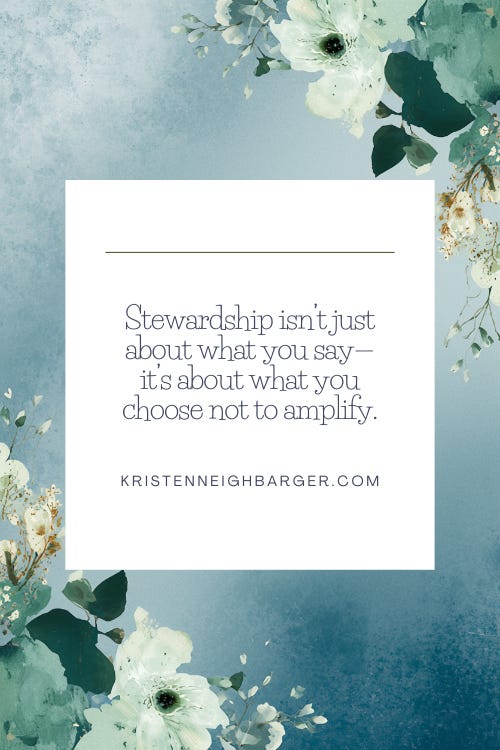
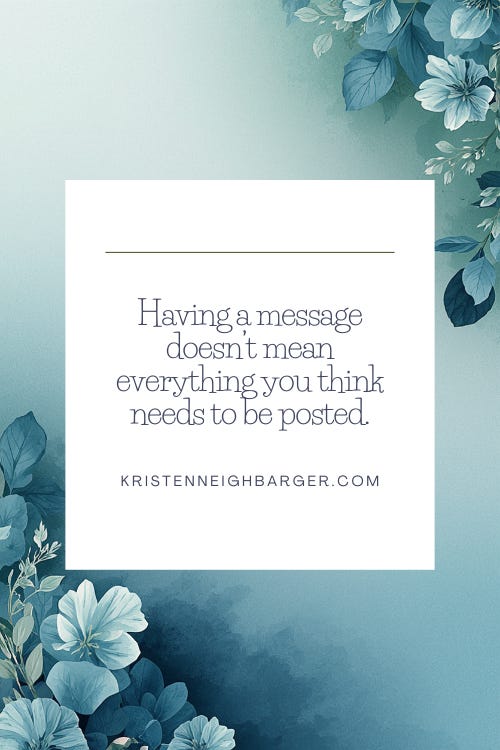
Having a message doesn’t mean everything you think should be posted.
Stewardship requires restraint.
Scripture talks a lot about being entrusted—with gifts, with responsibility, with influence. A calling isn’t just something we possess; it’s something we’re asked to care for. And care almost always involves discernment.
Social media tempts us to confuse authenticity with impulsivity.
But being authentic doesn’t mean being unfiltered.
And being honest doesn’t mean being unedited.
Sometimes maturity looks like typing the post… and then deleting it.
A Few Anchors for Staying Aligned
If you want your media to match your message—and your message to last longer than a moment of angst—these practices matter.
1. Know the message you’re stewarding.
If you can’t name it clearly, you can’t protect it. Write it down. Put it somewhere visible. Let it guide what you say and what you don’t say.
2. Run a litmus test before you post.
Ask yourself: Does this deepen the work I’m called to do—or distract from it? If it doesn’t enrich the message, it doesn’t need airtime.
3. Write for your actual reader.
This sounds obvious, but it’s surprisingly easy to forget. Content created for overwhelmed homeschool moms looks different than content for burned-out ministry leaders. When you write for everyone, you serve no one.
4. Be mindful of what you amplify.
Sharing other voices has its place—especially in stories. But your platform shouldn’t be a collage of borrowed convictions. People follow you because they want your voice, shaped by your wisdom and lived experience.
Some Thoughts Are Meant to Stay Private
When I was a tween, my dad used to tell me, “Just because you think it doesn’t mean you should say it.”
Annoying.
Accurate.
Timeless.
I have plenty of thoughts that don’t belong on the internet. You probably do too. And when we’re entrusted with a message—especially one that involves faith, healing, or vulnerable people—that discernment matters even more.
If it doesn’t mature the message, it doesn’t need to be published.
Before your next post—pause.
Ask yourself:
Is this helping the reader I care about most?
Is this aligned with the message I want to be known for a year from now?
You don’t have to post everything you think to be faithful to your calling.
Sometimes the most meaningful stewardship is choosing clarity over immediacy—and trust over urgency.
Reflection Questions
What message do I believe I’ve been entrusted with—and could I name it in one sentence?
Are there recent posts (or drafts) that felt more reactive than aligned?
Who am I actually writing for right now—and what do they need most?
Where might restraint be an act of faith rather than fear?
What would it look like for my online presence to reflect maturity, not urgency?
If you find yourself realizing you’re not totally clear on your message or your reader, you’re not alone—and you’re not behind.
I have a couple of low-pressure resources that help authors slow down and sort through those questions thoughtfully: The Writer’s Reset and The Connected Author. They’re there if and when you need them—no rush, no urgency, just support.
I write in two spaces. A Seat at the Table is where I explore faith, healing, and making room for honesty after it’s been made complicated. Ink & Intention is for writers who want to show up with clarity, discernment, and integrity—especially online.
I’m also the author of Breathing Again and several guided journals, and I work with writers who want thoughtful, grounded support as they find their voice and shape what comes next.
If something here resonated, you’re welcome to explore more at your own pace. You can find everything in one place here: