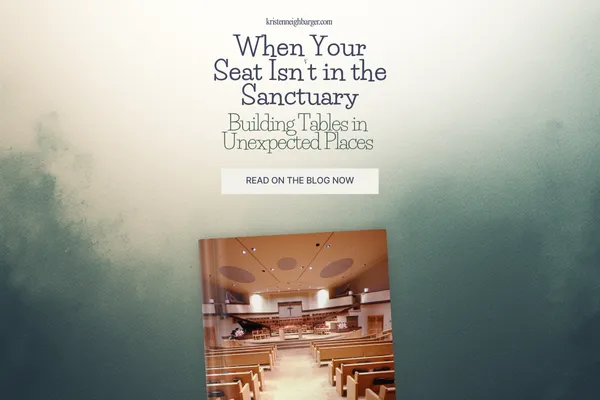
When Your Seat isn't in the Sanctuary
When Your Seat Isn’t in the Sanctuary
I didn’t go to church for six weeks.
Not because I don’t love Jesus.
Not because I was upset with my church.
Not because I was too lazy to get out of bed.
I didn’t go to church for six weeks because instead of going to church, I was busy being the church.
Or at least being what the church should be.
This might not be a popular opinion, but the hard truth is that we—people who profess to love and follow Christ—have to pay attention to who Christ is, what Christ did, and what Christ taught if we truly want to follow the example He set for us.
What Luke 17:7–8 Really Teaches About Discipleship
Here’s what Christ taught His disciples:
“After a servant has finished his work in the field or with the livestock, he doesn’t immediately sit down to relax and eat. No, a true servant prepares the food for his master and makes sure his master is served his meal before he sits down to eat his own. Does the servant expect to be thanked for doing what is required of him? So learn this lesson: After doing all that is commanded of you, simply say, ‘We are mere servants, undeserving of special praise, for we are just doing what is expected of us and fulfilling our duties.’”
—Luke 17:7–8 TPT
Jesus isn’t condemning worldly work here. He’s telling His disciples that their earthly work isn’t their only work. And He’s not glorifying exhaustion—He’s illustrating that discipleship isn’t about claiming religious status. It’s about showing up for the work of love.
Attendance vs. Obedience: A Misalignment in Modern Faith
I have to be honest—too often, church-folk mistake showing up on Sunday mornings, lifting their hands during worship, wearing the right clothes, and putting on a shiny, happy smile as fulfilling their spiritual purpose.
We’ve confused attendance with obedience. Jesus never did.
The hallmark of discipleship isn’t proximity to sacred spaces; it’s participation in sacred work.
Jesus’ teachings centered on serving the underserved, fighting for the marginalized, healing the sick, offering hope to the hopeless, and showing grace and mercy to the undeserving.
Not with lip service.
With action.
And this lip service—and this obsession with proximity to sacred spaces—is part of what limits the seats at the table. Sometimes the reason you don’t feel like you have a seat at those tables is because those tables were never yours to begin with.
I said what I said.

Why Some of Us Don’t Feel at Home in the Sanctuary
The reality is that you’re probably working your “real job” 40–50 hours a week. Then add household responsibilities, family obligations, kids, and everything else, and you might have eight hours left to eat and sleep during a full day.
This world isn’t designed to make space for spiritual work.
So something has to give if we want to do God’s work.
And sometimes, the thing that has to give is sitting in a seat on Sunday mornings.
Our culture points to seats, services, and concerts as symbols of “good Christianity,” while Jesus pointed to fields, tables, roadsides, wells, prisons, dinner parties with questionable guests, and the margins of society.
One of these things is not like the other.
So maybe the reason you’re struggling to find your place at the table is because you’re trying to sit in a seat that was never meant for you.
Maybe God Is Calling You to Build the Table
At the homeless shelter.
Around your own dinner table.
In your living room.
At the hospital.
In the nursing home.
At the prison.
At your parents’ house.
And maybe that means you forego the pews for six weeks in favor of rehabbing your parents’ place—because that, too, is the Lord’s work.
Why?
Because Jesus never told His disciples to build bigger sanctuaries.
He repeatedly told them to serve, invite, heal, and welcome.

Discipleship Is Active, Not Passive
If we’re going to embrace discipleship, then we have to make time for the Father’s work—because discipleship is active, not passive.
And this isn’t theory for me. This is what discipleship looked like in our own lives this fall. For my husband and me, discipleship meant spending six entire weekends working on his parents’ house. Getting up at the crack of dawn. Working ourselves to the bone until dusk. Standing in the gap. Serving where we could.
Without apology for not sitting in the seats on Sunday morning.
Hear me when I say this—this is not my anti-church-attendance manifesto.
Don’t come at me with pitchforks and holy water or put me on your prayer list over this.
(You can pray for me—just not about this.)
Church is important.
Community is important.
Worship is important.
But the Father’s work is equally important.
The church should not simply be our destination; it should be our launch point.
If we’re actually following Jesus’ teachings on discipleship, we have to be open to the fact that following Him might look like leaving the building to love people who would never walk into it.
Reflection for the Journey
Consider these questions as you discern where God may be calling you now:
1. Where do you sense God inviting you to show up in a real, tangible way—outside of traditional church spaces?
2. What “tables” might God be calling you to build—places of belonging, compassion, or refuge?
3. Who in your world right now needs the kind of love Jesus offered outside the sanctuary?