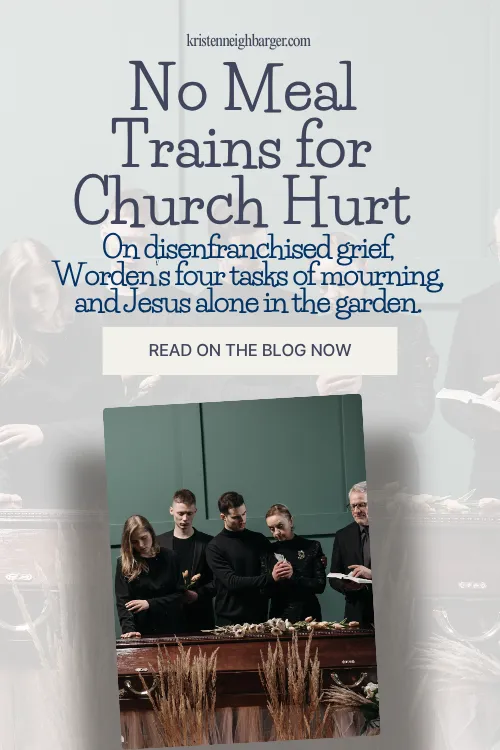
No Meal Trains for Church Hurt
The car was silent as Russ and I left church.
Ten minutes into our drive, Russ finally said, “I’m just so angry. I feel like I’m cycling through all the stages of grief.”
I sat with his admission for a few minutes, attempting to process my own thoughts and emotions alongside his. Immediately, I thought back to when I was writing Breathing Again and insisted on including a chapter on the grief that accompanies religious trauma and church hurt.
Grief was the very thing I was experiencing again. I just hadn’t labeled it yet.
As soon as I did, though, Russ’s anger made perfect sense. We were sitting in the rubble of relationship-shattering church hurt — the table where we’d broken bread, served, and ministered for years, suddenly decimated. We knew what we were feeling, but we didn’t have the language for it.
There are no meal trains for relational church hurt.
No funeral potatoes for betrayal.
No sympathy cards for the decimation of a table.
Instead, there is mostly silence. And when there isn’t silence, there’s well-meaning but inadequate response — sympathy without a path, understanding without a script.
Kenneth Doka coined the term disenfranchised grief (Disenfranchised Grief: Recognizing Hidden Sorrow, 1989) to refer to grief that is not openly acknowledged, socially accepted, or publicly mourned. The grief we feel from relationship-shattering church hurt is often disenfranchised grief.
One of the problems with disenfranchised grief is that there are no acceptable rituals, timelines, or guidelines for how to ease the pain of the grieving. Most of us are already uncomfortable with ordinary grief. So when we encounter grief that doesn’t fit neatly into socially acceptable categories, we often don’t know how to respond.
And so, we do nothing.
For ourselves when we’re experiencing disenfranchised grief.
Or for others when they are.
This is especially true with church hurt. We aren’t just dealing with ordinary disappointment; we’re processing hurt at the hands of those we trusted to guide us spiritually. This specific kind of hurt cuts deeply because it touches the very framework we used to understand God, safety, trust, and belonging.
That is part of what makes this grief so disorienting. The losses are real, but they are often invisible to the people around us. No one sees the collapse of trust, the unraveling of belonging, or the spiritual confusion sitting underneath the surface. Because there is no funeral, no public ritual, and often no clear ending, people don’t always recognize this as grief at all. And when grief goes unnamed, it often goes unsupported too.

Jesus in the Garden and the Grief We Don’t Talk About
All of this has me thinking about Jesus’s last evening with His disciples.
The story of Jesus’s last supper with His disciples is one many of us have heard a gazillion times. Our churches talk frequently about Jesus washing their feet, the beginning of the ritual of communion, and the revelation of Judas’s upcoming betrayal.
What we tend to gloss over is the bickering over who will sit at the right hand of Christ, the jockeying for position of the one Jesus loved the most, and how thoroughly Jesus’s closest friends still didn’t grasp the fate Jesus was preparing them for and grieving Himself.
Even when they leave and go to the garden and Jesus specifically asks them to keep praying for strength (Luke 22:40), they fall asleep. Jesus was in the garden begging God to take the cup from Him, sweating blood, and His friends were sleeping.
Jesus grieved in the presence of His friends who couldn’t even stay awake for it.
Then, as if on cue, Judas appears with a mob and betrays Jesus with one single kiss (Luke 22:47).
Jesus’s last evening with His friends and disciples was one full of betrayals, hurts, and disappointments. Again and again, these men who had been ministering with Him for three years fell short. And Jesus was left to wrestle with His own disenfranchised grief among the friends who should have walked the path with Him.
I don’t tell you this to minimize your grief. I tell you this because I want us all to understand we are not alone in our grief, even when we have been betrayed by those we once ministered with or who once ministered to us. The path through disenfranchised grief isn’t an easy one, but it is one we can complete in time.
When we look at Jesus’s time in the garden, we see an honest man experiencing grief and all the emotions that follow. He is honest about His desire for God to take the cup from Him. He is so overcome by the pain of grief that He sweats blood under the weight of it.
What we don’t see Jesus doing is minimizing the pain. We don’t see Him acting like everything is fine, like He’s fine. We see Him honestly mourning His path, pouring His pain out in agony.
Alone.
While His friends slept.
What strikes me most about Jesus in the garden is not just the depth of His grief, but the honesty of it. He doesn’t bypass it. He doesn’t rush to resolution. He experiences it fully and openly before God.
As I’ve been trying to process my own grief lately, I’ve found myself returning to both this example set by Jesus and to Dr. William J. Worden’s four tasks of mourning from Grief Counseling and Grief Therapy. Though Worden originally wrote about grieving the death of a loved one, his framework maps surprisingly well onto disenfranchised grief too. Not because grief is linear or formulaic, but because grief requires movement. It asks something of us as we learn how to live with what has been lost.
Worden describes grief not as a series of neat emotional stages we pass through once and leave behind, but as active tasks of mourning we return to and wrestle with over time. These tasks are not linear. We may move back and forth between them repeatedly depending on the depth of the loss and the circumstances surrounding it.
What I appreciate most about Worden’s framework is that it gives language to the work grief requires of us without shaming us for how long that work takes. Healing from deep loss is rarely quick, tidy, or straightforward — especially when the loss involves betrayal, spiritual harm, or the collapse of a community we once trusted.
Worden identifies four tasks that help us process grief and slowly acclimate to life after loss: accepting the reality of the loss, experiencing the pain of grief, adjusting to a new environment, and eventually reinvesting emotional energy elsewhere.

The Four Tasks of Mourning After Church Hurt
If you are sitting in the disenfranchised grief of a decimated table, your emotions are valid. You can’t heal from this loss overnight. It takes time, honesty, and acclimation to a new normal.
1. Accept the reality of the loss.
With relationship-shattering church hurt, our losses are great — community, friendships, systems we believed in, acceptance, etc. Our lists go on and on. While these losses don’t include physical deaths, they do include the deaths of things we know and love.
Our worlds will change with these losses. To process the grief accompanying these losses, we have to accept the reality of the loss.
In the garden, Jesus did just this. He did not deny the reality of what was coming. He named it honestly, even as He begged for another way.
2. Experience the pain of grief and all of the emotions that follow.
The pain of loss evokes different emotions at different times for all of us. While I sat in the hurt for quite some time, Russ moved quickly from hurt to anger. The same might be true for you and your loved ones.
How you experience this loss may evoke different emotions in each of you. Experience them all. Remember they are valid.
Jesus models this for us in the garden too. He does not suppress His anguish or rush past it spiritually. He allows Himself to fully experience the sorrow, fear, and agony of the moment in the presence of God.
3. Adjust to the new environment without the people or situation.
Adjusting to a new environment does not happen overnight. It takes time, especially if the situation involves a church community, friendships, or pastoral leadership you have been involved with for years.
The reality is this: it might take time to find your new normal and to be able to thrive in a new environment altogether or in the old environment without the people you knew and loved.
4. Withdraw emotional energy and reinvest it in another relationship.
This one seems harsh when we first read it — Worden himself softened the wording in later editions for the same reason, because at first, it can sound like he’s saying we just need to move on.
The focus, though, is on how much emotional energy we are investing in the loss vs. how much we are investing elsewhere. One thing I have said over and over in this experience is how much power I’ve given this situation in my life because of the amount of emotional energy I’ve spent on it.
Investing emotional energy in the people and situation is necessary while you are working through the loss, the emotions, and the adjustment.
To move forward in a healthy way, though, means withdrawing that energy from the loss and reinvesting it elsewhere — a different relationship, a new church, a ministry in the existing church, or something entirely different.

Permission to Grieve What Was Lost
The grief you are feeling from relationship-shattering church hurt is real grief, and the loss is catastrophic. Even though your friends aren’t going to show up with meal trains, funeral potatoes, or sympathy cards, your loss is real and your emotions are valid.
Let me give you permission to grieve it that way. To not minimize it because the world around you doesn’t have a category for it. To take the time, and the honesty, and the acclimation period this loss actually requires.
As you navigate this grief, my prayer for you is health and healing — mental, emotional, and spiritual — as you walk this long road.
Reflection Questions
What loss are you currently grieving that doesn’t fit a socially acceptable category? What has it cost you to keep grieving it without language for the grief?
Which of Worden’s four tasks feels most urgent — or most stuck — for you right now? What about that task is hard?
What permission do you need to give yourself to grieve this loss honestly — without minimizing it, performing through it, or rushing past it?
I write in two spaces. A Seat at the Table is where I explore faith, healing, and making room for honesty after it’s been made complicated. Ink & Intention is for writers who want to show up with clarity, discernment, and integrity—especially online.
I’m also the author of Breathing Again and several guided journals, and I work with writers who want thoughtful, grounded support as they find their voice and shape what comes next.
If you’re a writer looking for thoughtful encouragement, practical strategy, and honest conversations about the writing life, you’re also welcome to join us inside The Visible Author Facebook Community.
If something here resonated, you’re welcome to explore more at your own pace. You can find everything in one place at KristenNeighbarger.com.