When the Emphasis is on the Wrong Syllable
The news cycle this week has me thinking way too much about what my husband, Russ, and I refer to as putting the em-PHA-sis on the wrong syl-LAB-le.
Those of you who spend all your television hours on streaming platforms without ads might not be aware of this, but this is prime political ad season on “regular TV.” That’s the term those of us in the Gen X and older generations use to refer to Network Television (NBC, CBS, ABC, and Fox). Those are the networks us old people watch “live.” I realize this is a foreign concept to the vast majority of viewers.
Anyway, it’s prime political ad season, and whoa, buddy, the mud, it is a-slingin’. These ads are absurd—like seriously ridiculous. They’re so bad that Russ and I literally just start laughing as soon as they come on TV. Once we get through the hysterics, we commonly look at each other and simultaneously say, “Do these actually work? How can anyone believe this stuff?”
I don’t think I’ve seen one truth communicated in any of these ads. Instead, they are full of character assassinations, half-truths, and soundbites taken out of context. The emphasis is very clearly on the wrong syllable.
But it doesn’t stop there.
When the technicality becomes the point
I’ve been reading articles that show up in my inbox regarding the Cornell Seven and Jane Doe. While I’m not going to dig into the case here because that’s not why you show up here on A Seat at the Table, I can’t stop thinking about how so many of the responses to this horrendous situation are also putting the emphasis on the wrong syllable.
I’ve read a lot about the definition of consent, the choices Jane Doe made, and what happens when judgment is clouded by drugs and alcohol. What doesn’t seem to be disputed is that this night included seven fraternity brothers, one woman, alcohol, and ketamine. And according to the civil complaint, there was also a group chat advertising her availability to other men.
What I haven’t seen nearly enough discussion about are the deeper fundamental questions regarding the culture surrounding that night. What had become normal enough that any of this could happen in a room full of people?
Why aren’t we talking about this?
I’ve seen plenty of folks talking about what she was wearing, that she was intoxicated, that she was using ketamine, and that she agreed to a threesome. Lots of people are emphasizing those details. But where are the folks asking what it says about a culture in which a group message allegedly advertising a highly intoxicated woman’s availability to other men could even exist?
Wrong syllable.
Because of everything that has happened with my own disappointing experiences with church hurt and pastoral leadership and my deep dive into the themes present in Death of a Pastor’s Wife, I’ve found myself reading about this Cornell incident, watching these political ads, and making comparisons to what happens too often in the church as well.
Because putting the emphasis on the wrong syllable doesn’t just happen in political ads or court cases. It happens in the church as well.
We do this in the church, too
Just last week, a friend commented on a Substack note about how she wasn’t allowed to be called “Children’s Pastor” because she was a woman. In fact, not only did they refer to her as the “Director of Children’s Ministry,” but they had to hold a special meeting to decide if they could even hire her simply because, wait for it, she’s a woman.
So many of us have been entrenched in theological traditions for so long, we can’t even see how some—or too many—of the things going on in our church systems are the epitome of putting the emphasis on the wrong syllable.
The ripples are far-reaching and can be utterly devastating when we become so focused on the rule, tradition, theology, accusation, or technicality that we lose sight of the human being standing in the middle of it.
Take my friend. Here was a woman who was gifted at pastoring children. Families trusted her. Kids were thriving under her leadership. She was doing the actual work of pastoring. The room spent its time and energy trying to decide if they could put “pastor” on her business card instead of looking at the fruit she was bearing.
Wrong syllable.
A pastor harms someone, and instead of asking Is this person safe? What happened to them? What do they need?, everyone starts debating whether what happened fits the denomination’s definition of abuse.
Wrong syllable.
Someone finally tells the truth about what happened in a church, and instead of investigating the allegation, people want to ask why they waited six months to come forward.
Wrong syllable.
A girl says a Sunday school teacher made her uncomfortable when he talked about spanking his wife, and the girl has to leave Sunday school while the teacher remained.
Wrong. Freaking. Syllable.
There is a propensity in our country, our culture, and our churches to seek out and focus on the technicality so we can avoid looking at the uglier question. We’ve made this normal.
What has become so normal that a church holds a special meeting to determine if a woman can lead children, and no one thinks twice?
What has become so normal that church members flag harmful behavior, and the conversation becomes a theological debate?
What has become so normal that protecting a ministry is more urgent than caring for the harmed?
What has become so normal that we can quote every chapter and verse on spiritual authority yet ignore every bit of evidence about the fruit that authority is producing?
Wrong syllable.
Jesus kept pointing to the weightier things
But the thing is, this isn’t the first time we’ve seen the emphasis being put on the wrong syllable, is it? Jesus was constantly confronting religious leaders who were completely focused on emphasizing the wrong syllable.
They were more concerned with Sabbath regulations while people were suffering, purity while someone needed mercy, and tithing tiny herbs while neglecting “the more important matters of the law—justice, mercy, and faithfulness.” (Matthew 23:23)
Wrong syllable.
Jesus wasn’t criticizing the Pharisees and the teachers of the law because they cared about obedience. He was criticizing them because somewhere along the way, getting the smaller things exactly right became more important than practicing the weightier things well.
We are remarkably capable of doing the same thing.
We can get the job title right but completely miss the woman at the center doing the work.
We can get incredibly precise about the definition of abuse and completely miss the person telling us they were harmed.
We can get the theology of authority right but completely miss the fruit.
We can follow every policy in the handbook and still fail the human standing before us.
Look at the fruit
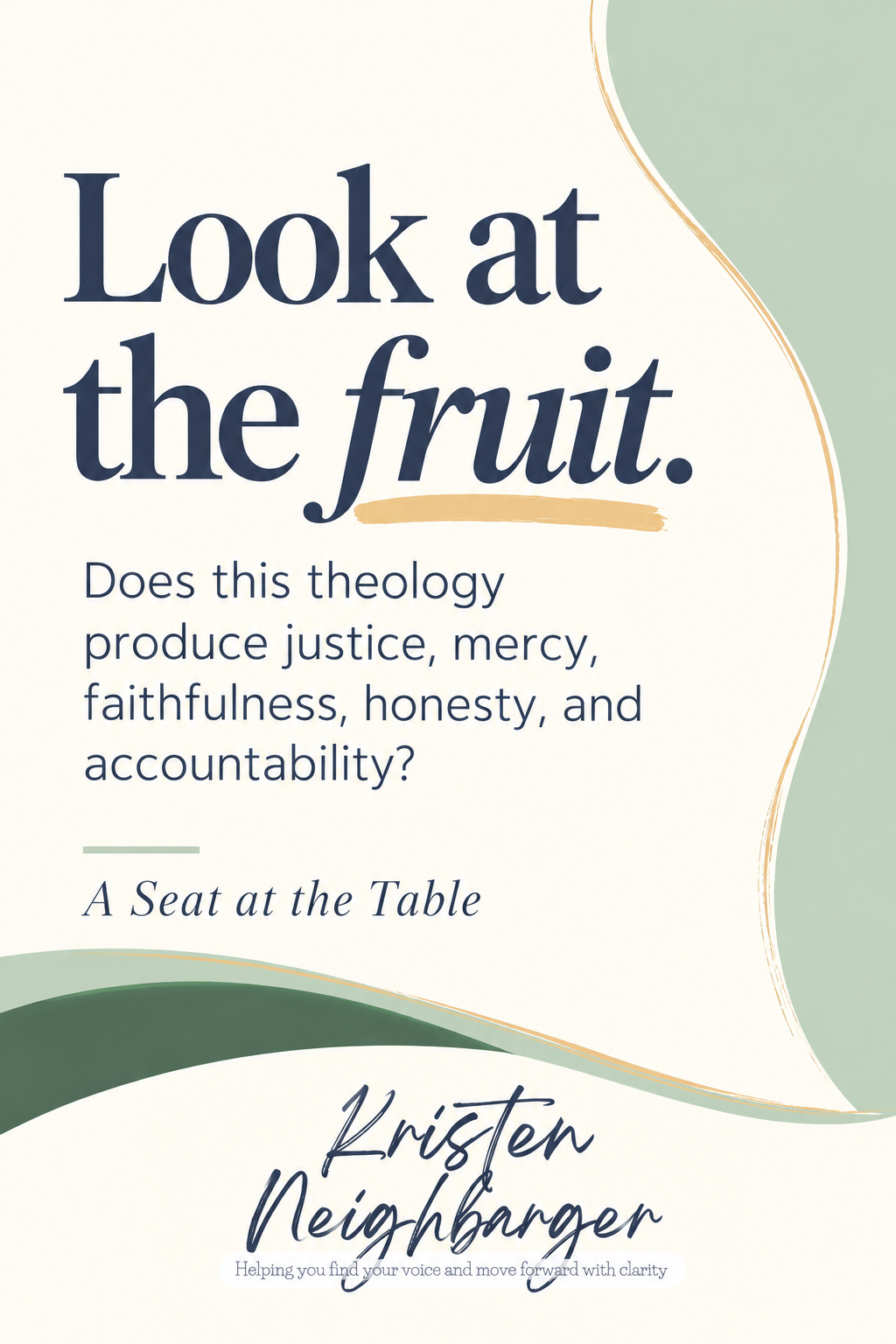
And that’s when the fruit comes in. When we’re unsure where the emphasis should be, we have to look at the fruit.
Does this theology produce justice, mercy, faithfulness, humility, love, safety, honesty, and accountability?
Or does it produce fear, silence, exclusion, protectionism, hierarchy, shame, and people learning that telling the truth will cost them more than causing harm?
Maybe one way we build stronger faith systems is by learning to recognize when we’ve put the emphasis on the wrong syllable.
We don’t need to throw out theology. We need to stop using theology to excuse fruit Jesus told us to pay attention to.
When we aren’t sure where the emphasis belongs, maybe we don’t need another committee meeting, another policy clarification, or another theological argument. Maybe we need to look at what Jesus actually emphasized.
Love. Justice. Mercy. Faithfulness. Fruit. People.
Because if our theology keeps requiring us to overlook the people standing right in front of us, there’s a pretty good chance we’ve put the em-PHA-sis on the wrong syl-LAB-le.
A few questions to sit with
Where have you seen churches become more concerned with getting the technicality right than caring for the person in front of them?
Are there theological traditions or church practices you once accepted without question that you now see differently because of the fruit they produced?
When theology, policy, or tradition and the wellbeing of people seem to collide, what helps you discern where the emphasis belongs?
I write in two spaces. A Seat at the Table is where I explore faith, healing, and making room for honesty after it’s been made complicated. Ink & Intention is for writers who want to show up with clarity, discernment, and integrity—especially online.
I’m also the author of Breathing Again and several guided journals, and I work with writers who want thoughtful, grounded support as they find their voice and shape what comes next.
If you’re a writer looking for thoughtful encouragement, practical strategy, and honest conversations about the writing life, you’re also welcome to join us inside The Visible Author Facebook Community.
If something here resonated, you’re welcome to explore more at your own pace. You can find everything in one place at KristenNeighbarger.com.