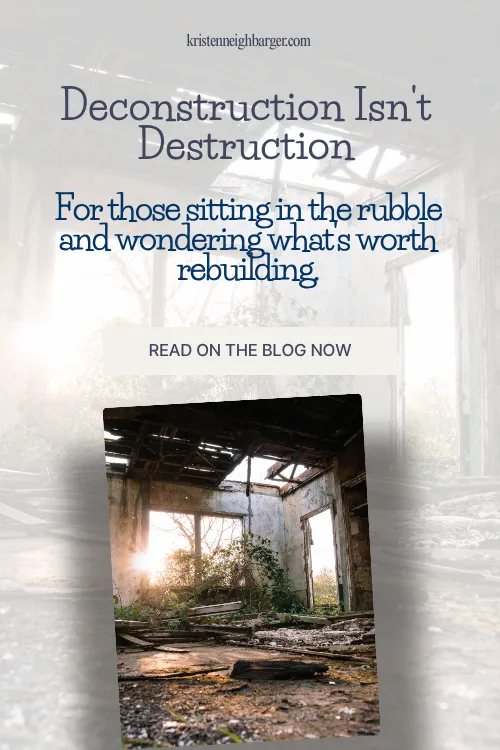
Deconstruction is not Destruction
My love for comfort food and comfort cooking was instilled in me from an early age.
Some of my earliest memories are of the kitchen at my Grandma Mary’s house.
If I close my eyes right now, I can still see the giant yellow Tupperware bowl sitting on the table full of the morning’s milking waiting for the cream to rise to the top so it could be skimmed off and put in the cream jar. I can see the black raspberry pie on the stove with the steam rolling off the crust right after Grandma took it out of the oven. And, I can see the pie on her plate drenched in that same cream she skimmed off earlier in the day.
The first thing I ever baked was at Grandma’s house–white cake with brown sugar icing.
I was 7.
And, from that moment on, I was fearless in the kitchen.
It would be many years before I would come to understand the skills and lessons I learned from my Grandma in the kitchen were rare, that the confidence she instilled me from such a young age was not the norm.
I didn’t learn to cook from recipes. I learned to cook from taste, texture, sight, and signs–to deconstruct dishes layer by layer to determine what they were made of so I could both recreate them and also so I could make them better.
Grandma taught me that taking something apart wasn’t an act of disrespect. It was how you learned to understand it.
It wasn’t until I got a bit older, ate dinner at friends’ houses, and started cooking with my friends that I realized my experiences in the kitchen were rare. Most of my friends and their families cooked from recipes. They followed a predetermined set of directions without straying. Their measuring spoons and measuring cups looked vastly different than my pinches and spoonfuls.
While we both arrived at similar creations, there were always subtle differences. After all, they had a set list of ingredients and steps they were checking off as they went, and I was creating from the lessons I had learned through my deconstruction of the dish in the past, sampling, and adjusting as I went.
Following the Recipe
The reality for many of us is that this is precisely what is happening as we wrestle with issues, questions, concerns, and hurt in our faith communities. We’re watching as people around us are following the same recipes for faith communities they’ve always followed, checking off the steps as they go. Meanwhile, we’re over here deconstructing those very same experiences to make them, and us, better.
I saw a Facebook post recently claiming how deconstruction was so 2000s, and we need to get back in the scriptures. For those of you who know me in real life, you can probably see the face I made as I read it. My gut reaction was to be completely offended because I felt personally attacked, my second reaction was anger, but I finally landed on just being sad–both for the original poster and also for those who share this line of thinking.
It’s heartbreaking to me that there are still so many people in our faith communities and beyond today who confuse deconstruction with destruction.
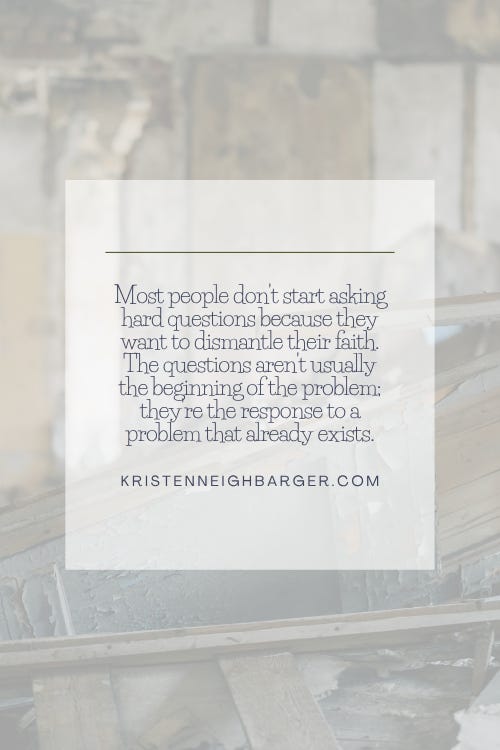
Most people don’t start asking hard questions because they want to dismantle their faith. They start asking hard questions because something no longer makes sense. They encounter abuse, hypocrisy, manipulation, exclusion, or teachings that don’t align with the character of Jesus they see in scripture. The questions aren’t usually the beginning of the problem; they’re the response to a problem that already exists.
Deconstruction Isn’t Destruction
For so many of us, deconstruction is not and has never been about destruction. It’s been about deconstructing the theology, system, and cults of personality prevalent in our faith communities. In the same way, I deconstruct dishes to determine the ingredients, we deconstruct the systems we belong to in an effort to determine the individual ingredients that make them what they are.
And, just like my goal is always to improve dishes, our goal in deconstruction is to make our faith stronger and our faith communities better.
To say we need to stop deconstructing and get back into the scriptures is an oxymoron.
The folks I have known and loved who have deconstructed or are constantly deconstructing are in the scriptures more than they ever were when they were blindly following the recipe of their faith community. They aren’t just in the scriptures, though. They are reading scholarly research, digging into context, listening to experts on podcasts, and becoming more and more educated and informed.
If this level of study scares those in church/faith community leadership, I see giant red flags waving.
Church leadership should not be scared by research and deep dives into scripture, context, and culture–it should be encouraged by it.
If it isn’t encouraged by it, we have to ask why.
When we deconstruct a dish, we don’t throw out the bowl. We dig deep to figure out each component. Then, when we recreate it, we figure out what works and what doesn’t, so we can improve it. When we deconstruct the faith handed to us in a faith community, we do the same thing. We look at all of the components. We study. Ultimately, we determine what is meant to be there, what isn’t, and what needs to change based on our scholarly research. We aren’t reaping destruction; we are deconstructing. Those are two very different things.
Sitting in the Rubble
Here’s the thing, though: deconstruction can look and feel like chaos–both from the inside and the outside. All processes take time, but this is a process that not only takes time but requires questions, and often unveils answers other people don’t like and don’t want to hear. This isn’t the same thing as destruction, though. It’s the difference between blindly trusting a recipe and utilizing a test kitchen.
Often, though, others in faith communities see our departure from blindly trusting a system to questioning it as destructive and divisive. They see us as the problem when our goal is truly to uncover the problems. We want improvement, where they want blind obedience.
Tables don’t typically withstand this tension.
There are so many of us sitting in the decimated rubble of tables we used to sit comfortably at. We’re looking around at the rubble, sorting through it, and trying to figure out what went wrong. We’re digging into scripture and research, studying psychology to understand personalities, and desperately just trying to figure out where we fit and at which tables we should sit.
Some of us are still sitting in the rubble with the people who blew up our tables, others have taken a step back and are wrestling with the fact that they can go back but are wondering if they should, and finally, others have left the rubble altogether and are on the hunt for a completely new table.
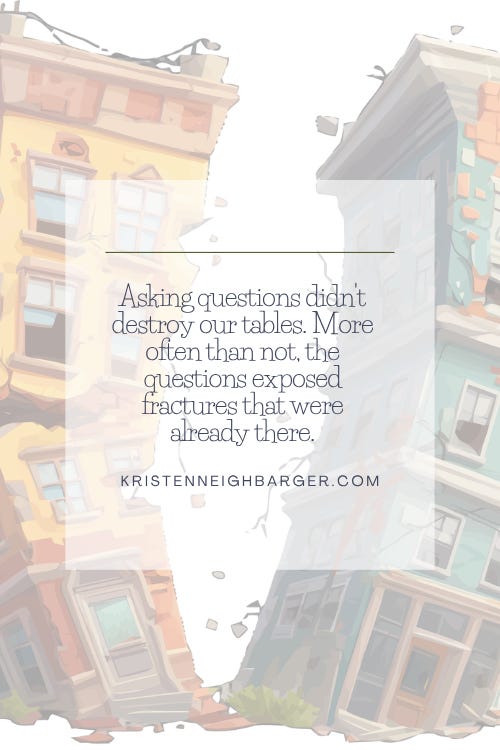
Asking questions didn’t destroy our tables. More often than not, the questions exposed fractures that were already there.
What we all have in common is this: we loved our tables so much that we were willing to ask the hard questions.
Maybe that’s where you find yourself today: sitting in the rubble of a table you loved, sorting through the pieces and trying to figure out what happened, trying to determine what was part of the table all along and what was added later, trying to decide what belongs, what doesn’t, and whether you even want to build another table at all.
If that’s where you are, I don’t have easy answers for you.
What I do know is this:
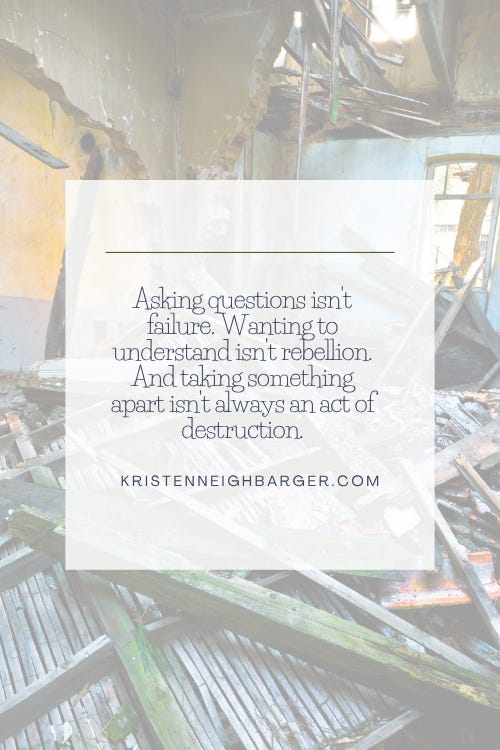
Asking questions isn’t failure.
Wanting to understand isn’t rebellion.
And taking something apart isn’t always an act of destruction.
We loved the table. We loved the people sitting around it. We loved the faith we were handed. We loved it enough that we couldn’t ignore the cracks when they started to appear.
Maybe that’s why so many of us are still here, sitting in the rubble, sifting through the pieces, studying, questioning, grieving, and hoping–not because we’re trying to destroy something, but because we’re trying to figure out what’s worth rebuilding.
Reflection Questions
What questions am I currently wrestling with, and where did those questions come from?
What assumptions or beliefs have I inherited without ever examining them for myself?
Are there areas of my faith that have actually grown stronger because I was willing to ask hard questions?
What pieces of the table am I holding onto, and what pieces might it be time to lay down?
I write in two spaces. A Seat at the Table is where I explore faith, healing, and making room for honesty after it’s been made complicated. Ink & Intention is for writers who want to show up with clarity, discernment, and integrity—especially online.
I’m also the author of Breathing Again and several guided journals, and I work with writers who want thoughtful, grounded support as they find their voice and shape what comes next.
If you’re a writer looking for thoughtful encouragement, practical strategy, and honest conversations about the writing life, you’re also welcome to join us inside The Visible Author Facebook Community.
If something here resonated, you’re welcome to explore more at your own pace. You can find everything in one place at KristenNeighbarger.com.