
Consistency
I am a creature of habit.
I like structure and routine in my day-to-day world. I get up every morning and do the exact same things. I take my coffee the same way. I eat the same things. I get up out of the rocker at the same time. I have the tried-and-true routines that I rely on for consistency every single morning.
Call it ADHD. It’s fine. You’re not wrong. Just figured I’d get that out of the way for those of you who are currently diagnosing me.
I digress.
I don’t rely on systems and routines for my mornings alone. I wear a bunch of different hats, and since I have lived the life of burnout in the past, I refuse to revisit it again. Routines and rhythms keep me consistent, dialed in, and on task even when my motivation is, shall we say, lacking.
I’ve talked to a ton of writers who are trying to figure out how to manage their lives while also wearing multiple hats. Many of them work full-time jobs, are married, have families, and are involved in their churches, on top of trying to do everything that comes with being an author.
I’d love to sit here today and tell you I have the solution to all of your problems. That, however, would be a lie. What I can offer you today are just a few suggestions for staying consistent even when you don’t feel motivated.
And I know you’ll find this shocking; they all relate to rhythms and routines.
Here’s the thing, authorly friends: writing routines are important. They really do keep you accountable to yourself and your deadlines, so while I joke about my obsession with rhythms and routines, the truth is they are what keep me on track and help me meet my deadlines.
Make Writing Time an Actual Appointment
The first rhythm to build into your schedule is designated writing time. Maybe it’s 15 minutes every morning. Maybe it’s the 30 minutes before you go to bed. Maybe it’s in the hour you have at lunch.
There is no right or wrong time to build those precious minutes into your schedule. You just have to find what is feasible and what works best for you. Then, physically add that time to your calendar. Make it an appointment and treat it as such.
It will only be important to you if you make it a priority.
And I know how easy it is for writing to become the thing we’ll get to once everything else is done. The problem is that everything else is never actually done. There is always another email, another load of laundry, another appointment, another thing someone needs from us.
If writing matters to you, it needs a place on the calendar before all of those other things crowd it out.
Create a Manageable System for Your Writing
Next, create a manageable system for your writing.
I publish my articles on Tuesdays and Wednesdays. That means they have to be written, edited, revised, formatted, and scheduled before Tuesday and Wednesday. It also means my Notes, Pinterest Pins, and IG Stories have to be created and scheduled before Tuesday and Wednesday.
My system looks like this: I check my calendar for the week to find open slots. Then, I schedule my writing time in those slots as actual appointments. During the first hour slot, I write my article. During the second, I do all the revising, editing, and repurposing. Rinse and repeat for article two.
That’s four hours a week of creation. And sometimes, it’s a challenge for me to find four hours a week. So, when I see those openings on my calendar, I fill them with my writing time.
Having a system in place also means I don’t have to sit down every day and ask myself what I’m supposed to be doing next. I’ve already made that decision ahead of time.
And for me, that matters.
Plan Before You Sit Down to Write
Lastly, I plan ahead.
I would not be able to create in an hour if I didn’t already have a plan for what I write each week. I’ve done the work to understand my author DNA and my reader DNA, so I know what my readers need from me. Since I have a clear picture of their needs, I can brainstorm article series in advance and know exactly which topic I’m addressing before I ever sit down at the computer.
Plus, I know the exact structure I use to write my posts. I start with a scene, offer a reflection, anchor it in Scripture for my faith articles and in practice for my author articles, and then offer action steps or applications for my readers.
I use that structure in almost every single long-form post I create. That doesn’t mean every article sounds the same. It just means I don’t have to stare at a blinking cursor every week trying to figure out where I’m going next.
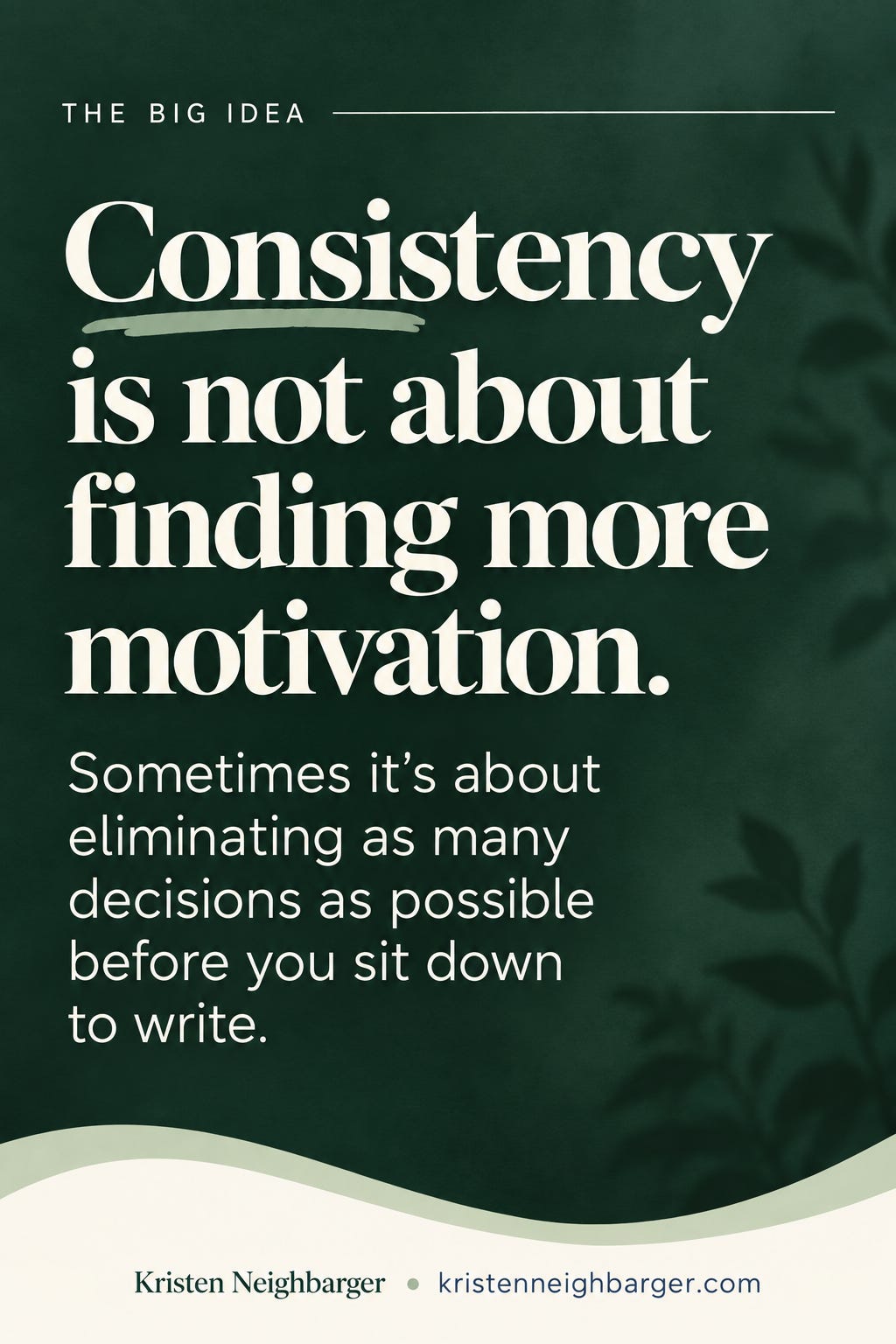
And I think that’s a big part of consistency that we don’t talk about enough. Sometimes consistency isn’t about being more disciplined or finding more motivation. Sometimes it’s about eliminating as many decisions as possible before you sit down to write.
You’ve already decided when you’re writing. You’ve already decided what you’re writing. You’ve already decided how you’re going to move through the process.
That makes it a whole lot easier to keep going when motivation disappears.
When Motivation Fades
If you’re sitting there today struggling to be consistent, let me encourage you to try just one of these rhythms this week. Carve out designated writing time, map out a series, or figure out your structure for your articles.
Try it for a few weeks and then adjust.
You do not need to completely overhaul your writing life, but you do need something in place that helps you keep moving when you don’t particularly feel like moving.
The trick to staying consistent, even when you lack motivation, isn’t about somehow wrangling up more motivation. It’s having guardrails in place to protect your writing and your writing time.
The hard truth is this – motivation is going to fade. There will be weeks when you are excited to sit down and write, and there will be weeks when you would rather reorganize the junk drawer than open your manuscript.
That’s when the routines matter.
Monday-you can make a few decisions ahead of time so Tuesday-you doesn’t have to start from scratch.

Reflection Questions
Where does your writing currently fit into your schedule? Is it protected time, or is it something you try to squeeze in after everything else is done?
What part of your writing process requires the most decision-making right now?
Which would help you most this week: designated writing time, a plan for what you’re going to write, or a repeatable structure for your articles?
I write in two spaces. A Seat at the Table is where I explore faith, healing, and making room for honesty after it’s been made complicated. Ink & Intention is for writers who want to show up with clarity, discernment, and integrity—especially online.
I’m also the author of Breathing Again and several guided journals, and I work with writers who want thoughtful, grounded support as they find their voice and shape what comes next.
If you’re a writer looking for thoughtful encouragement, practical strategy, and honest conversations about the writing life, you’re also welcome to join us inside The Visible Author Facebook Community.
If something here resonated, you’re welcome to explore more at your own pace. You can find everything in one place at KristenNeighbarger.com.