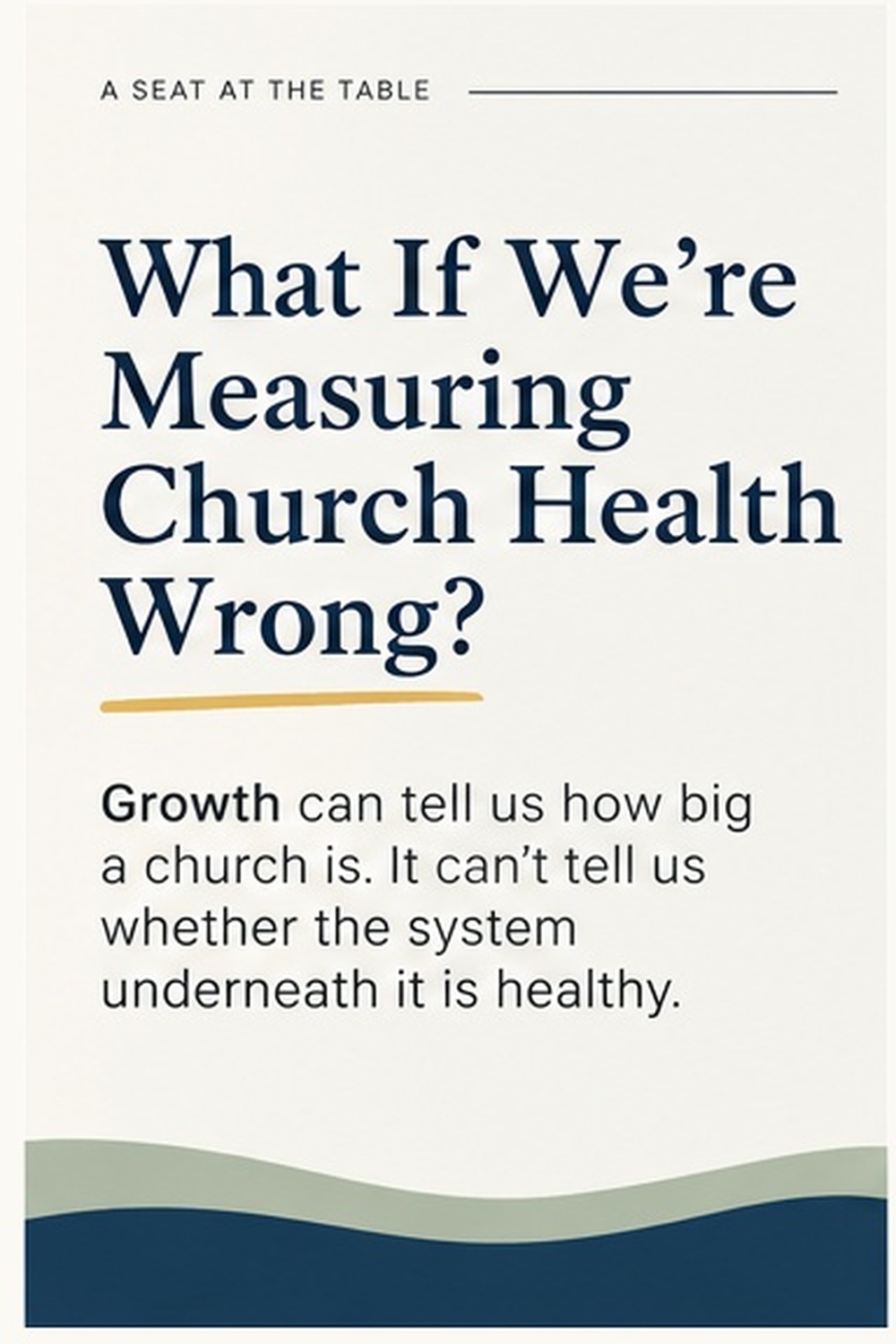
What If We’re Measuring Church Health Wrong?
Lately, all of the discussion around Death of a Pastor’s Wife has me thinking about how we build healthy spiritual practices and healthy faith organizations. And it has me thinking back to my 30s and my quest for health during those years.
When I was in my early 30s, I decided to get healthy. I did the very stereotypical things people do when they make the declaration to get healthy–started exercising daily and downloaded a calorie-counting app. I did this quietly at first, not wanting anyone else in on my quest for health.
What started as a genuine desire to become healthy turned unhealthy after a few months. My running went from 45 minutes five days a week to 90 minutes seven days a week–45 minutes in the morning and 45 minutes in the evening. My calorie deficit went from healthy weight loss to disappointment if it wasn’t in the 1,000-calorie-a-day range.
After losing close to 40% of my body weight, my dad finally looked at me and said enough was enough.
The strange thing is that if you had looked only at the things we typically associate with health, I probably looked pretty healthy.
The number on the scale was going down. I could run farther than I had ever been able to run. I was disciplined. I was exercising. I was paying attention to everything I ate.
The numbers said I was succeeding.
My actual health said something very different.
Thankfully, I was able to stop my very unhealthy quest for health. The health itself, though, didn’t follow. That took years, planning, therapy, and structure. It took retraining my brain and body to understand what health actually looked like, and it took hard work to find healthy spirituality and healthy relationships.
Looking back now, I think one of my biggest problems was pretty simple: I was measuring the wrong things.
And lately, I’ve been wondering if we do the same thing in our churches.
What Are We Measuring?
We know how to measure church growth.
Attendance.
Giving.
Baptisms.
Volunteers.
Small groups.
Campuses.
We know when those numbers are going up, and we know how to celebrate them when they do. We look at a church that is growing rapidly, adding services, launching campuses, baptizing people, and filling seats, and we assume something healthy must be happening there.
But growth and health aren’t necessarily the same thing.
Let me pause here and say this clearly: I’m not an expert on church health. In fact, I’m not even an expert on human health. I’m just someone who has been hurt by both religious systems and pastoral leadership in two different systems who sees a need for rethinking what a healthy church looks like and what a healthy church does.
So, if you’re someone else who feels the same way, welcome to my table.
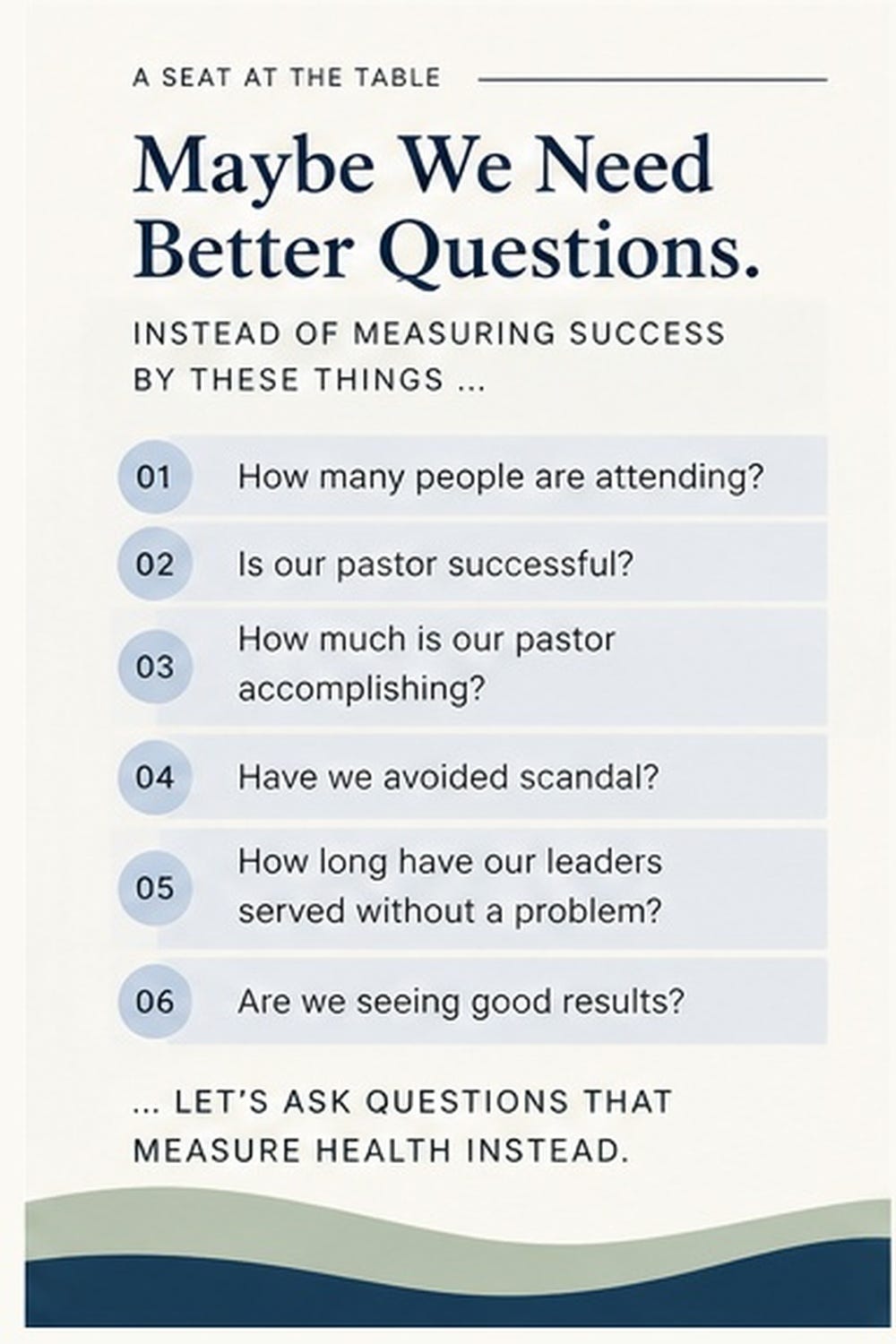
Maybe We Need Better Questions
Before anyone comes at me with “the Bible is our manual,” I want to address that elephant in the room. I’m going to try to say this as delicately as possible. Every church system I’ve been part of that ended up in crisis — and nearly every one I’ve watched a documentary about or read about — claimed in some form to be a Bible-following church.
So, yes, we have Scripture as our guide. But people interpret, manipulate, and weaponize Scripture in all sorts of unhealthy ways. Saying, “We follow the Bible,” doesn’t automatically create healthy structures any more than saying, “I’m trying to get healthy,” made everything I was doing healthy.
We need to look beyond words to actions. We have to look at the fruit, and fruit isn’t always seen in numbers. After being involved in two church systems in crisis, watching too many documentaries, reading too many articles, and talking to too many people, I’ve come to the conclusion that while there isn’t a specific manual for creating healthy church systems, there are some questions we have to be willing to ask that help us recognize the fruit a little better and build healthier systems.
Let’s look at the questions we typically ask to determine a church’s success and replace them with questions that measure health instead.
Maybe instead of only asking how many people are attending, we also need to ask: How safe is it for those people attending to tell the truth here?
Can someone say, “Something isn’t right,” without immediately becoming the problem?
Are questions treated as information worth considering, or are they treated as insubordination?
Maybe instead of asking whether our pastor is successful, we need to ask: Who has power, and who can tell that person no?
And I don’t mean theoretically. I mean structurally.
Who can actually remove a pastor?
Who investigates allegations against leadership?
Who has access to information?
Is accountability independent of the person being held accountable?
If the person at the top of the organizational chart is the same person with the most influence over everyone responsible for holding them accountable, how much accountability actually exists?
Maybe instead of measuring how much our pastor is accomplishing, we need to ask: What happens when a leader isn’t doing well?
Pastors are human. They experience burnout, addiction, grief, marriage problems, anxiety, depression, physical illness, family problems, and seasons where their judgment may not be what it normally is.
What structures are in place before any of those things become a catastrophe?
Are there professionals involved?
Is counseling available?
Is there outside accountability?
Can someone step away from leadership without it being treated as punishment or failure?
We talk all the time about how people can’t pour from an empty cup, but sometimes our church structures seem perfectly content to let pastors keep pouring until the cup is shattered on the floor. That isn’t good for pastors. And it certainly isn’t good for the people they’re pastoring.
Maybe instead of measuring health by how successfully we’ve avoided scandal, we need to ask: Would we know what to do if someone were harmed?
Who would they tell?
What would happen next?
Would the institution instinctively protect its reputation and leadership, or are there processes already in place that center truth, accountability, appropriate care, and safety?
Would the person reporting harm have to figure everything out while they were already hurting, or would the church already know what to do?
Instead of assuming a lack of public problems means accountability is working, we need to ask: What does accountability actually mean here?
Is accountability treated as care or punishment?
Is there a clear process that allows for stepping away, confession, repentance, repair, counseling, spiritual mentoring, and healing?
And does that care extend in both directions — toward the leader and toward the people affected by the leader’s actions?
Grace matters. Care matters. Restoration matters. But none of those things require us to pretend nothing happened.
And maybe instead of assuming good results mean good fruit, we need to ask: Can our system recognize unhealthy fruit before the whole tree falls over?
Are there checks and balances?
Are there honest conversations about fruit built into the system through things like outside accountability, assessments, contracts, spiritual mentorship, elder oversight, and regular conversations about the health of leadership?
And when the fruit isn’t good, what happens?
Because noticing unhealthy fruit doesn’t do much good if everyone notices it and nobody has the authority — or courage — to do anything about it.
Would the Church Still Be Healthy Without the Person at the Center?
This may be one of the questions I keep coming back to most: What happens if the charismatic person at the center is removed? Does everything fall apart? Can the church continue functioning if the senior pastor leaves tomorrow? Can leadership change without the entire identity of the church changing with it? Are relationships, ministries, decisions, and information spread throughout the organization, or does everything eventually run through one person?
A healthy church system cannot depend on the health, judgment, self-awareness, or willingness to seek help of one leader. That’s not a system. Systems require groups of people, policies, accountability, communication, and an understanding of how all the moving parts work together to create one cohesive whole.
Too often, though, unhealthy church systems depend solely on the goodness of good people. And it only takes one good person making a not-so-good decision for the whole thing to start falling apart. Healthy churches need more than good intentions from good leaders. They need structures that remain healthy even when the people inside them struggle.
A church can have a fantastic pastor who loves people and genuinely wants to follow Jesus. Build accountability anyway.
A church can have elders who trust one another. Build transparency anyway.
A church can have a congregation that has never reported abuse. Build reporting procedures anyway.
A church can have a pastor who appears emotionally healthy. Build structures to support their mental health anyway.
A church can have leaders who have never appeared to abuse their power. Build checks and balances anyway.
Not because we should walk into church every Sunday assuming everyone is secretly terrible. Because people are human. And humans will fail.
We Shouldn’t Need a Crisis to Get Healthy
Maybe this is the part I’ve been wrestling with the most since watching Death of a Pastor’s Wife: Why do we wait until something breaks?
Why does it take a pastor falling apart, someone being harmed, an investigation, a resignation, or an entire church being thrown into crisis before we start asking questions about accountability, power, transparency, and care? By then, we’re trying to figure out how to respond to damage that has already been done.
I don’t want that to be the only time we talk about healthy church systems.
I want us to have these conversations when things are going well. When we love our pastors. When we trust our elders. When attendance is growing and giving is strong and nobody is standing at the microphone making an announcement none of us ever expected to hear.
That’s when we build the structures.
Not because we’re suspicious of everyone in leadership, but because healthy systems shouldn’t require perfect people to stay healthy.
People will make bad decisions. People will miss things they should have seen. Someone will eventually need help. Someone will need accountability. And sometimes someone will need to be told no.
A healthy system has room for all of those things without requiring everything to fall apart first.
Maybe that’s what I’ve been trying to put words around through all of this. I don’t want churches to get better at surviving crises. I want us to get better at building churches where fewer things have to become crises in the first place.
Reflection Questions
What have you traditionally used as evidence that a church is healthy? Has anything you’ve experienced caused you to question whether those things actually tell you what you thought they did?
Think about a church system you’re part of now or have been part of in the past. How would it answer some of the questions we’ve asked here about power, accountability, transparency, leadership health, and what happens when someone is harmed?
What is one structure you think churches could put in place before a crisis happens that would better care for both leaders and the people they lead?
I write in two spaces. A Seat at the Table is where I explore faith, healing, and making room for honesty after it’s been made complicated. Ink & Intention is for writers who want to show up with clarity, discernment, and integrity—especially online.
I’m also the author of Breathing Again and several guided journals, and I work with writers who want thoughtful, grounded support as they find their voice and shape what comes next.
If you’re a writer looking for thoughtful encouragement, practical strategy, and honest conversations about the writing life, you’re also welcome to join us inside The Visible Author Facebook Community.
If something here resonated, you’re welcome to explore more at your own pace. You can find everything in one place at KristenNeighbarger.com.