When Bad Theology Makes Abuse Easier
I found myself down the rabbit hole of the comments section on a slew of social media posts last week. I’m not one of those people who follow social media accounts just to be enraged by what they post. No, no. My philosophy of social media is to fill my feed with information and posts that feed my soul. In fact, when I start to see posts that promote ideas, theology, and people I wouldn’t promote myself, I’m more of the “unfriend” and “unfollow” type of consumer.
I tell you this to explain that the posts I was reading were posts I was cheering for. They were filled with information I was championing, theology I was shaking my head at, and scriptural interpretation I was quick to support.
The comment sections, however, were not quite so supportive.
What I found especially interesting was that the original posters in each scenario filled their posts with facts. They stated their position and then supported it with numerous quotes, facts, and even references to video clips.
When I went to the comment sections, though, whoa buddy, people were Big Mad.
They attacked the OP’s character.
They quoted random scripture verses.
They called the OP a multitude of very creative names.
They cursed the OP to eternal fire and damnation.
They had a lot to say about all sorts of things, but they didn’t have much to say about the facts, quotes, and actual video clips in the original posts.
It was fascinating.
The damning evidence was in print and video right in front of them, and yet, they couldn’t even see it.
Last week I talked about why Death of a Pastor’s Wife felt all too familiar to me, and this week I’m still sitting in the déjà vu, only this week I want to delve into why bad theology makes abuse easier. And, interestingly, much of it relates to these folks in the comment sections of these social media posts I was reading.
When Theology Teaches Us Who Is Responsible
For those of you who don’t know my background, I grew up in an extremely legalistic, verging on fundamentalist non-denominational church in the Midwest. My family got out when I was in my 20s. Well, my family was pushed out when I was in my 20s, and I’ve spent the last 20 years dismantling the harmful theology of the first two decades of my life.
I am intimately familiar with both what I saw happening in the comment sections of my socials last week and with the theology that opened the door to spiritual abuse in Mica Miller’s life and her church. If I’m being honest, I used to be amazingly skilled at arguing in the same way those keyboard warriors were attacking and in adhering to the dangerous theology present in Mica Miller’s church.
The longer I’ve been separated from the brainwashing and indoctrination, the more I’ve been able to see the dangers of the theology and how it opens the door for abuse.
I started going to church camp in 4th grade. Even as 4th graders, we had to wear black or navy T-shirts over our swimsuits during swim time so we would not cause the boys to sin. I can’t decide whether I want to focus on the fact that we were fourth graders or on the fact that, even before I was 10 years old, I was being taught that other people’s actions were my responsibility.
They’re both equally damaging, so I suppose I’ll start with the pressure put on girls to be responsible for boys’ thoughts and actions.
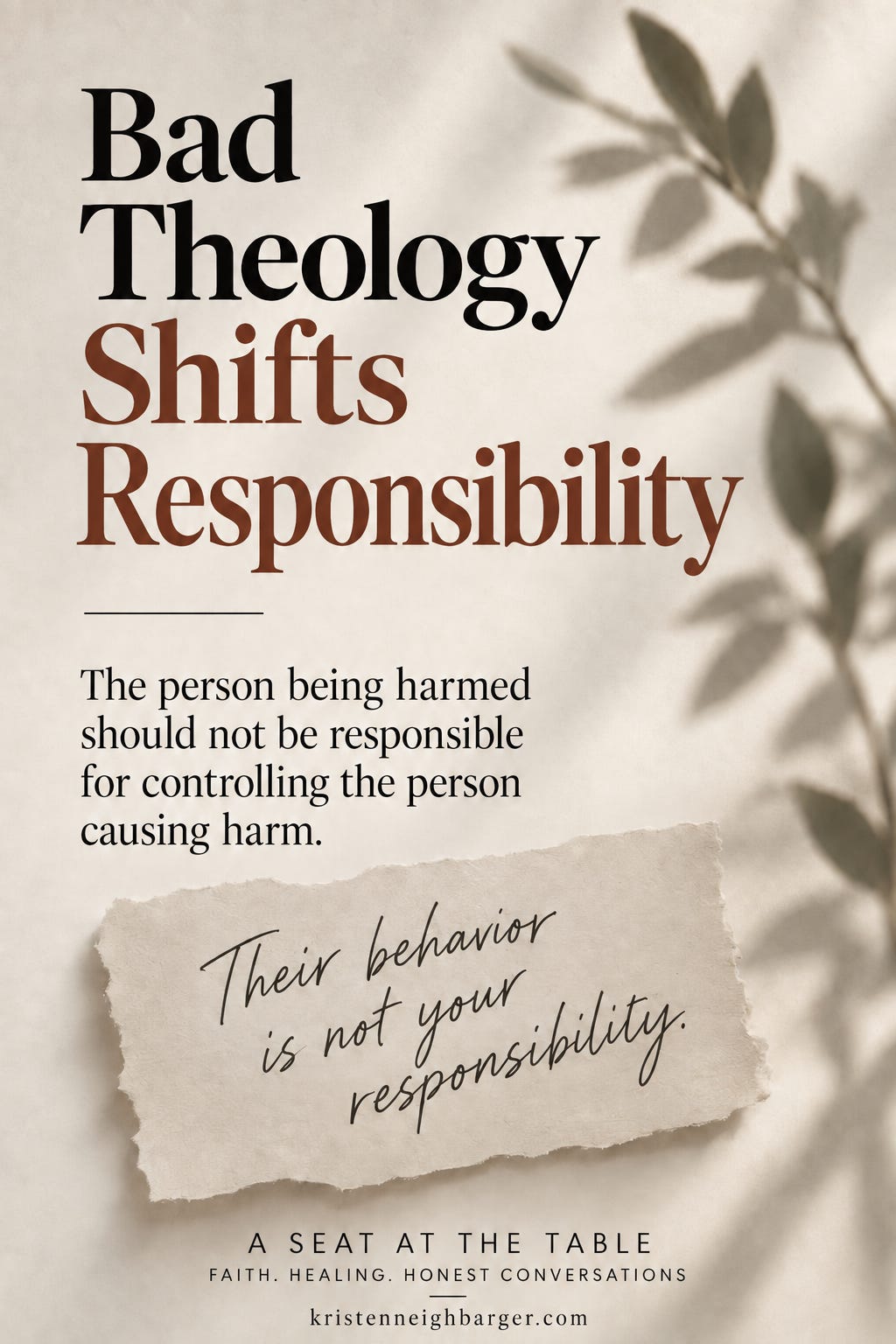
As a child, I was brainwashed to believe I had to wear a shirt over my swimsuit so I would not cause boys to lust. At no point in this teaching was the responsibility for boys’ behavior put on their shoulders. As girls, we were taught we were the ones with self-control. We were the ones who had the power not to cause our Christian brothers to stumble. Their actions were our responsibility.
Think about how this belief expands and explodes as both these girls and boys get older and enter into relationships. If the theology says it is on the girl to control the boys’ behavior, then when they’re adults, this same theology says it’s on the wife to control her husband’s. This is the very essence of the theology that preaches to women that they should never say no to their husbands’ desire for physical intimacy. It is the same theology that says it is the responsibility of the wife to keep the husband’s physical desires met so that he won’t “stray.”
It goes even deeper than this, though, because this is the same theology that indoctrinates husbands to believe it is their God-given right to have access to their wife whenever they want access. It is the same theology that teaches husbands that their wives are being sinful when they refuse their physical advances. It is the same theology that teaches husbands that if their wives make them wait more than three days between physical contact, it’s understandable that they would look elsewhere, like we saw preached from the pulpit in Death of a Pastor’s Wife.
For some of us, we read these words and think, “That’s ridiculous! How could anyone believe this is okay?” But, for the rest of us, we recognize the language, the teachings, and the abuse that so easily follows. We recognize how harmful theology shifts responsibility away from the person causing harm.
When Faithfulness Becomes Endurance
After all, it’s the same thing that happened on those social media posts I read last week. It didn’t matter how many facts the OP gave. It didn’t matter how much evidence they offered. The commenters could not see what was real because they were so focused on their own indoctrination.
That’s another way bad theology can make abuse easier. When we’ve been taught to both believe something and defend it by people we love and respect, we struggle to see its holes. I saw this again and again throughout Death of a Pastor’s Wife. The bad theology Mica Miller knew made more sense to her than the reality that was right in front of her. It felt more natural for her to hold out hope that if she just did more, prayed more, was a better wife, etc., God would work everything out for her.
Bad theology does just that. It creates an environment where hope for God to work everything out for the good seems like a better option than accepting the awfulness of their reality. Add to that the fact that if they don’t trust God to work everything out for the good, their theology has taught them it means they are bad Christians or don’t have enough faith.
Bad theology teaches the person being harmed that faithfulness means enduring more.
This opens the door even further for abuse. It prevents individuals from holding others accountable, acknowledging the harm being done, and escaping toxic relationships, dysfunction, and ultimately abuse. Why? Because it opens the door for the abuser to continue to get worse and worse because the survivor has accepted the responsibility of the entire situation as their own, as something they can change if they are just a better Christian.
When Scripture Is Used to Keep People Trapped
This is so important — there is a difference between trusting God in suffering and believing God requires you to make yourself available to someone who is harming you. The church has Christianized all sorts of phrases and taken all sorts of scripture out of context. You’ve heard them too:
God hates divorce.
Turn the other cheek.
Forgive seventy times seven.
God works all things together for good.
Love keeps no record of wrongs.
None of these texts were intended as instructions for enabling abuse. None of them absolve the person causing harm of responsibility. Pulled out of context, though, and applied disproportionately to the person being harmed, they become incredibly effective tools for keeping someone trapped.
When we’ve been taught to think this way, to process information this way, and to see the world through this theological lens, it becomes increasingly difficult to separate ourselves and our experiences from the theology itself. The result is that we tend to lean toward supporting a system or church rather than examining the fruit.
When Defending the System Becomes Defending God
Think about the comment sections. These individuals weren’t necessarily incapable of understanding the evidence before them. They had a theological framework that dictated the conclusions they were allowed to reach before they ever looked at the evidence.
And that is terrifying.
Once defending a church, pastor, institution, or doctrine becomes synonymous with defending God, questioning any of them becomes the same as questioning God Himself. Before we know it:
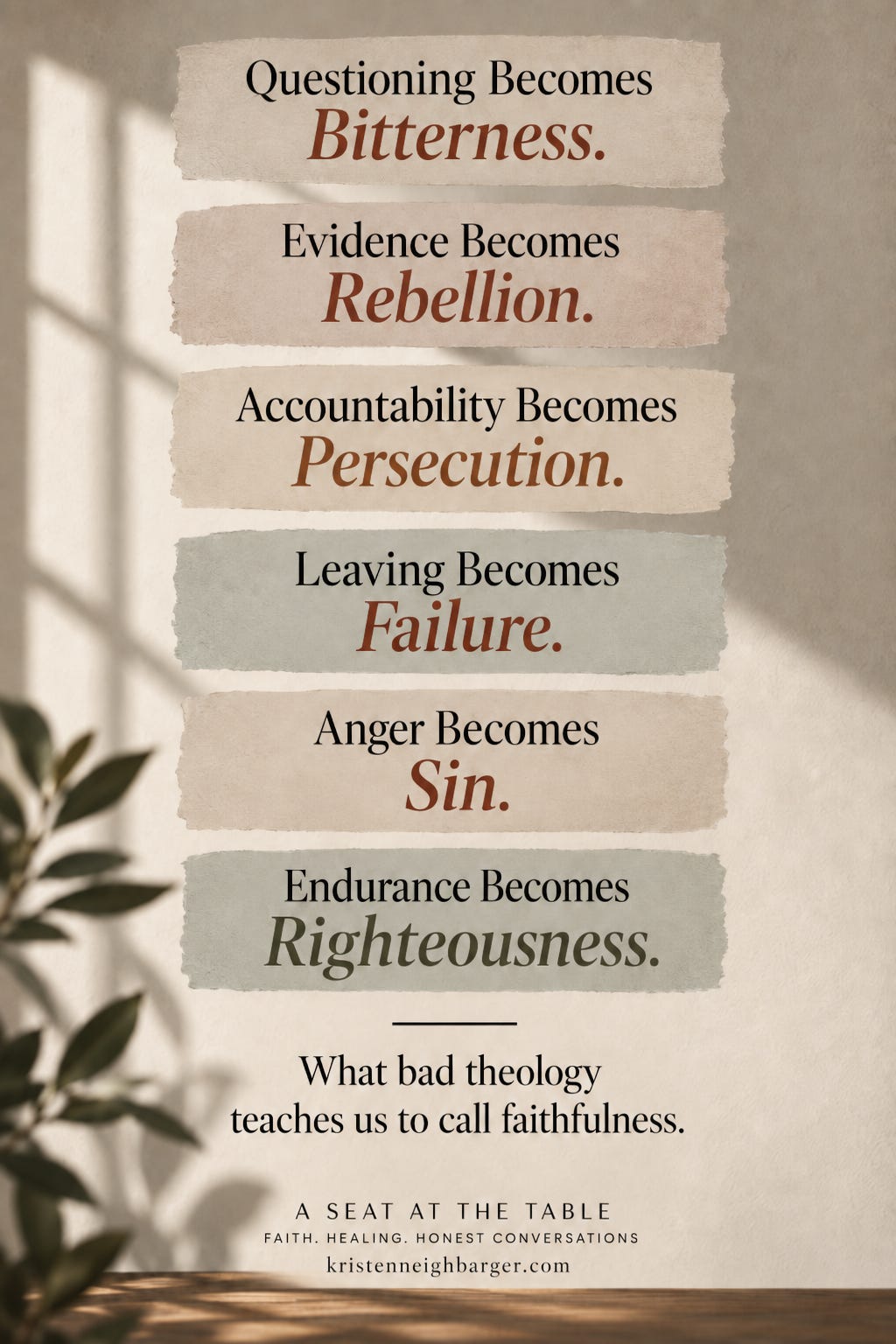
Questioning becomes bitterness.
Evidence becomes rebellion.
Accountability becomes persecution.
Leaving becomes failure.
Anger becomes sin.
And endurance becomes righteousness.
Theology Produces Fruit Too
Hear me when I say this — we don’t need to throw out all theology. We do, however, need to take a hard look at our theology and make sure it says:
People are responsible for their own behavior.
Forgiveness does not guarantee access.
Submission is not silence.
Reconciliation requires repentance.
The wounded are not responsible for repairing what someone else keeps breaking.
Maybe, most importantly, our theology should make abuse harder to hide, harder to justify, and harder to continue because theology produces fruit too. If the fruit of our theology is silence, coercion, control, fear, victim-blaming, protection of powerful people, and endless grace for the person causing harm while demanding endless endurance from the person being harmed, we have to be willing to ask if the theology itself needs to be reexamined.

Reflection
What theological beliefs were you taught about responsibility, submission, forgiveness, or endurance that you have had to reconsider as an adult?
Have you ever watched a church, leader, or community protect a system or institution rather than honestly examining the harm it causes? What made it difficult for people to see what was happening?
When you look at the fruit of the theology you were taught, what has it produced in your life—and is there anything you now believe needs to be reexamined?
I write in two spaces. A Seat at the Table is where I explore faith, healing, and making room for honesty after it’s been made complicated. Ink & Intention is for writers who want to show up with clarity, discernment, and integrity—especially online.
I’m also the author of Breathing Again and several guided journals, and I work with writers who want thoughtful, grounded support as they find their voice and shape what comes next.
If you’re a writer looking for thoughtful encouragement, practical strategy, and honest conversations about the writing life, you’re also welcome to join us inside The Visible Author Facebook Community.
If something here resonated, you’re welcome to explore more at your own pace. You can find everything in one place at KristenNeighbarger.com.