Among You
Pull up a chair.
Raise your hand if you’ve ever woken up on a predicted “rapture” date and quietly checked to make sure your friends and loved ones hadn’t been taken while you were left behind.
(Cue the Frank Peretti trauma.)
Do you know how many times in the last decade “experts” have predicted a rapture-esque event?
Me either.
But I do know this: there have been quite a few—and they all have one thing in common.
They didn’t happen.
And yet, every time one of these predictions gains traction—especially over in the TikTok universe—people who have done the hard work of healing find themselves feeling some sort of way.
For good reason.
If you carry trauma from rapture sermons or fear-based theology…
If your body still twitches when people talk about how they “can’t wait to die” so they can finally experience heaven…
If end-times talk sends you spiraling faster than you’d like to admit…
This one’s for you.
A passage that’s been mishandled for generations
One of my favorite (least favorite? most frustrating? honestly—what is the right word here?) face-palming, bad-theology sermons is the one about the kingdom of God.
Luke records a lengthy teaching from Jesus at the end of chapter 17—a passage that’s been used as fodder for wildly westernized visions of the afterlife for generations.
You can read it in Luke 17:20–37, but here’s the short version:
Religious leaders ask Jesus when the kingdom of God will come.
Jesus responds that the kingdom of God is among them.
Later, Jesus expands on this teaching with his disciples.
He speaks of suffering, rejection, and upheaval—drawing from the stories of Noah, Lot, and Sodom.
He warns that people will be living normal lives, unaware of what’s unfolding around them.
Some will be swept away. Others will be left alive.
Life, Jesus says, is found in surrender—not self-preservation.
And the signs? They’ll be obvious. Like vultures circling what is already dead.
It’s a lot.
And it’s been taken out of context… a lot.
“Now. Among you.”
For some reason, the opening of this teaching is often overlooked.
When Jesus is asked when the kingdom of God will come, he answers—immediately—with now.
“The kingdom of God is among you.”
Now.
Among you.
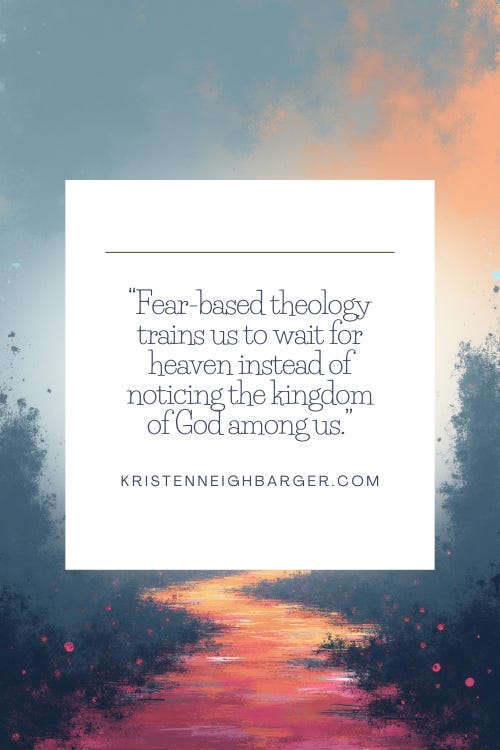
And yet, this passage keeps getting twisted into a fear-based narrative where the faithful escape to heaven and the sinners are left behind.
Except that’s not what Jesus says.
In the stories Jesus references—Noah, Lot, Sodom—the ones taken are the ones swept away by judgment.
The ones left are the survivors.
Jesus isn’t teaching an allegory about the afterlife here.
He’s teaching about the kingdom of God in the here and now.
Why this matters so much
Since deconstruction and reconstruction, I’ve struggled to put my finger on why so many people seem more obsessed with the afterlife than with the world right in front of us.
I don’t have a perfect answer.
Some of it is conditioning.
Some of it is hope.
For many, it’s about reward.
But I also think—if we’re honest—acknowledging the kingdom of God in the present means we have to confront injustice and do something about it.
And that’s hard work.
The times Jesus references in this teaching weren’t neutral or peaceful eras. They were marked by deep injustice.
And yet—
People lived as if everything was normal.
They married, built homes, ran businesses, went about their days—largely unaware of what was unfolding around them (Luke 17:28–30).
To acknowledge the kingdom of God in the here and now means risking comfort.
It means loosening our grip on security.
It means surrendering our lives to Jesus.
And Jesus wasn’t exactly a quiet, comfortable presence.
He was a countercultural revolutionary who centered the marginalized, confronted systems of power, and aligned himself with the least of these.
This isn’t about escape
Jesus circles back to the ordinariness of daily life—sleeping, working, keeping house—and reminds his listeners: one will be taken, one will be left alive.
And here’s the part that matters.
Jesus focuses on the one left alive.
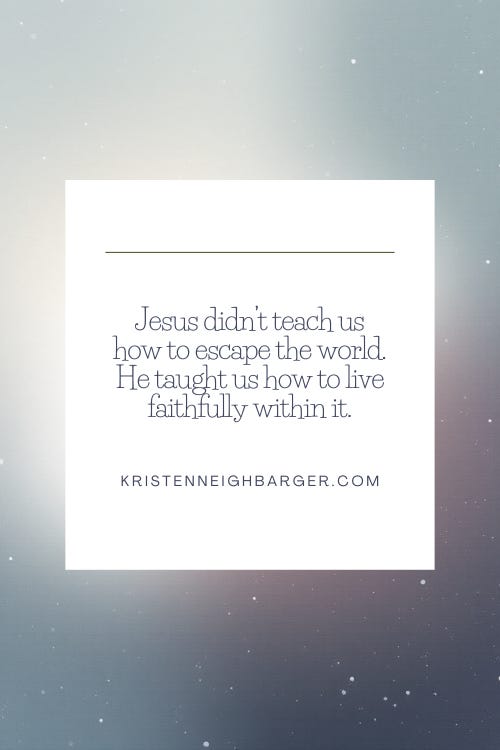
This isn’t about escaping the world.
It’s about being faithful within it.
The disciples ask the same question the religious leaders asked: When?
Jesus’ answer is essentially: You’ll know.
When decay is visible.
When vultures are circling what is already dead.
In other words—when injustice is normalized and no one seems bothered by it anymore.
A different kind of kingdom
The kingdom of God Jesus is talking about isn’t an abstract future meant to scare people into behaving so they can get into heaven.
It’s the world we’re living in right now.
And we have a choice.
We can surrender our lives to the teachings of Jesus and follow his example in the present.
Or we can keep living for tomorrow—comfortably distracted—while injustice overruns the world around us.
Sometimes, I think it’s easier to focus on a future kingdom than to reckon with the one unfolding in front of us.
In that version of faith, the focus stays on us—
our behavior,
our quiet times,
our spiritual scorekeeping.
In Jesus’ version, the focus shifts outward.
To how we love.
To who we include.
To whether we’re building bigger tables and making room for those pushed to the margins.
And that—
That’s hard work.
If this is your story…
If you’ve struggled in faith spaces where the focus has been on getting to heaven more than it’s been about being like Jesus in the here and now—you aren’t alone.
If you’ve woken up in the middle of the night during a thunderstorm and listened for the trumpets with nothing but fear—you aren’t alone.
And if something in you longs for a faith rooted in presence instead of panic,
a faith willing to build bigger tables,
to surrender to the teachings of this countercultural Jesus,
and to contend for the kingdom of God in the here and now—
You aren’t alone either.
There is room here at this table for you.
Pull up a chair.
Reflection
What emotions or memories surface for you when you hear talk about the rapture or “end times”?
In what ways have you been taught to focus more on getting to heaven than on living out the kingdom of God here and now?
What might faithfulness in the present look like for you in this season—without urgency or fear driving it?
(You don’t have to answer all of these. Sit with the one that sits with you.)