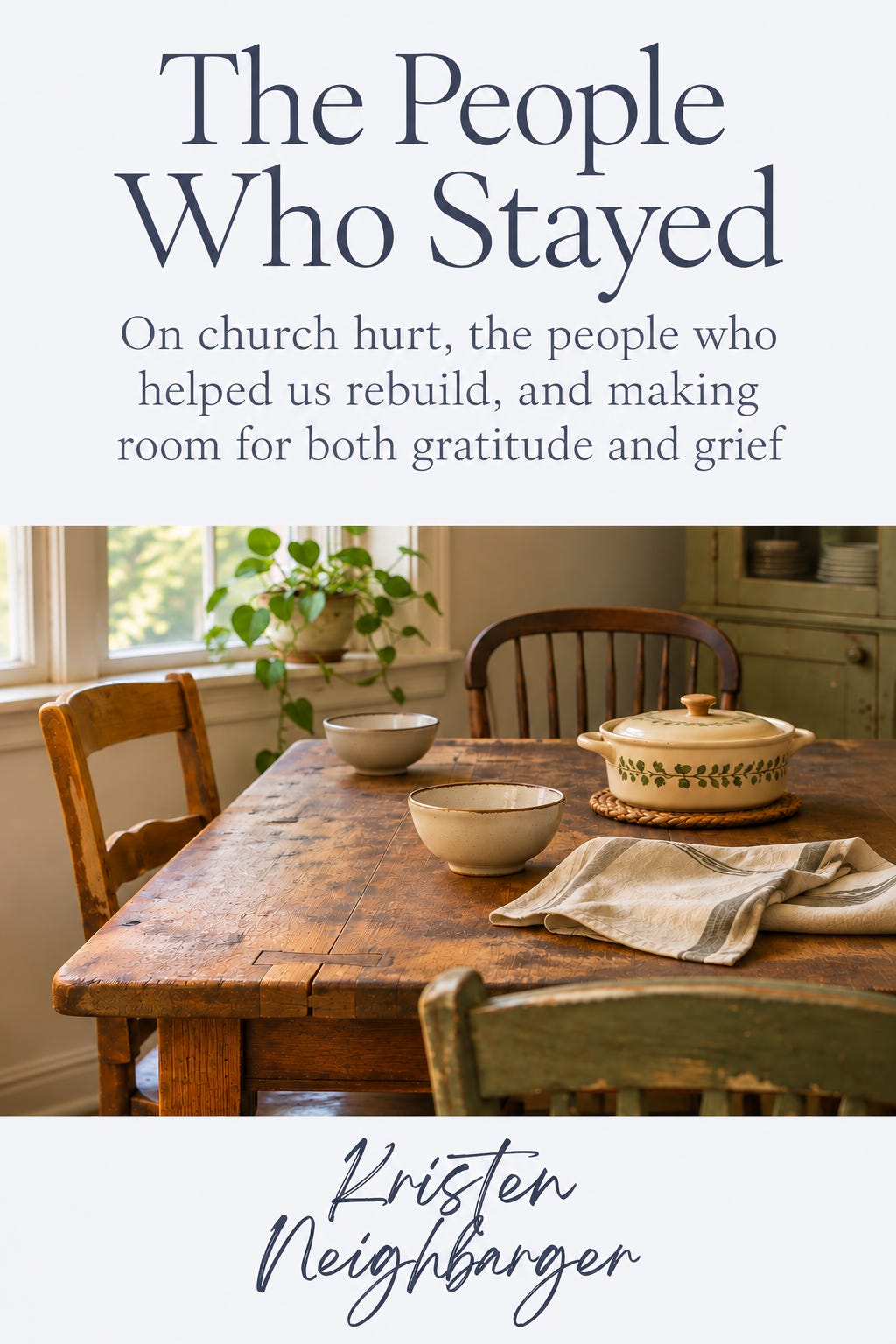
The People Who Stayed
If you’ve been around here for a bit, then you probably know it’s been a year for my family. If you’re new here, first, welcome. I’m glad you chose to pull a seat up to my table.
When You Lose a Church Home
20ish years ago, my family was enmeshed in a legalistic evangelical/pseudo-fundamentalist church. We had been in the same “non-denomination” my entire life and the same church for 20-plus years. My dad was an elder who was deeply committed to both the church and God.
The church’s small groups were all doing Henry Blackaby’s Experiencing God. It changed my dad’s relationship with God, the Holy Spirit, and the church.
Not everyone liked those changes.
Soon, my dad and several others who had been changed by Blackaby’s study found themselves ousted from leadership, and we found ourselves spiritually homeless.
There are a ton of layers to that story that I have peeled back slowly and deliberately. Through the grace of God, the Holy Spirit, and therapy, I’ve worked through the spiritual abuse and religious trauma I experienced during all of those years. It was hard work.
And it’s important context to understand where I am now. I know what it feels like to be spiritually homeless, what it feels like to lose the foundation of your faith that held you in place. I know the fear, confusion, anger, and grief that come with losing a church home you thought you would be at forever.
I know church hurt intimately, and I was convinced it was never going to be part of my story again.
The Ashes Are Still Settling
A year ago, my family found itself sitting in a completely different type of church hurt. We love our church, but we chose to step away as the situation unfolded. We had some hard decisions to make. We sat with our emotions, acknowledged our grief, and decided what our non-negotiables were.
I spent those months away studying spiritual authority, accountability, forgiveness, confession, repentance, restoration, grace, repair, and relationships. And I spent a lot of time with Jesus and felt the nudges of the Holy Spirit as we waited.
While we’re personally on the mend, we’ve also seen the church respond both biblically and with compassion. Because both are necessary. I look around every Sunday and see beauty blooming despite the ashes left over from the devastation.
And the ashes are still there. They’re still settling.
So many people were hurt. So many tables were decimated.
But so many people stayed to rebuild.
This is a hard season for people sitting in the rubble of their tables. Everywhere we look, we’re bombarded with gratitude. We’re asked to see the good, and too often that comes at the expense of ignoring the bad. This November, my goal has been to make room for both the good and the bad in our hearts — for the gratitude and the grief.
Today, I don’t want us to pretend like the devastation didn’t happen. That won’t help anything. But I do want us to take a few minutes to be grateful for the people who stayed—the people who sat with us in the devastation and listened with compassion and empathy. The people who — even though they might be hurting too — have stayed to rebuild.
What Staying Looks Like
We talk about Ruth and Boaz in church pretty regularly. It makes sense. We love a good redemption story in the church, and Disney has made us all love a good “and they lived happily ever after” fairy-tale-esque story. Ruth and Boaz’s story has all those tropes.
While we hit Ruth and Naomi up every once in a while in women’s Bible study, we could all learn a thing or two from their relationship. We should definitely talk about them more.
If it’s been a minute since you’ve read their story, you can find it in the book of Ruth in the Old Testament. It’s just four short chapters and is worth a read. Naomi and her family left Bethlehem and went to Moab to try to avoid famine. Naomi’s husband died there. Her sons married Moabite women, and years later, both of her sons died, leaving Naomi and her daughters-in-law without their husbands.
Naomi had lost so much. In the middle of the devastation of her table, though, she urged her daughters-in-law to go back to their families. One daughter-in-law, Orpah (not to be confused with Oprah), chose to go back to her family. Ruth was free to go home, too. She chose, though, to go with Naomi.
Let’s just sit with this for a minute. Naomi’s table is blown to smithereens. She chooses to offer Ruth freedom and grace. Ruth’s table is also blown to smithereens, and she chooses to stay with Naomi and rebuild their decimated table together.
My favorite part is what Ruth says to Naomi here.
But Ruth replied, “Don’t urge me to leave you or to turn back from you. Where you go I will go, and where you stay I will stay. Your people will be my people and your God my God. Where you die I will die, and there I will be buried. May the Lord deal with me, be it ever so severely, if even death separates you and me.” When Naomi realized that Ruth was determined to go with her, she stopped urging her.
Ruth 1:16–18 NIV
Ruth could have gone home. Who would have blamed her? She chose to stay and help Naomi rebuild.
Once they get to Bethlehem, we get to see what staying and rebuilding looks like. Ruth spends the day gleaning in a field and brings home what she gathered for Naomi. (Ruth 2:17–18) Maybe you can relate to Ruth. Maybe your table is gone, but staying and rebuilding looks like something as simple as bringing dinner.
But maybe you can relate to Naomi here. Maybe this season has been filled with loss. Maybe you are looking around at a devastated and destroyed table and are on a journey to find a new home or to return to an old home. And maybe, like Naomi, you are grateful for the person who keeps showing up — bringing dinner, listening to you, and supporting you while you figure out what comes next.
The People Who Helped Us Rebuild
That’s where we found ourselves.
We didn’t know what we were going to do about church, whether we would find a new home or return to our old one. And the last thing we wanted to do was encourage others to be spiritually homeless with us. We didn’t talk to people about the situation unless they approached us. Like Naomi, we wanted everyone else to feel free to make the choices that were best for them and their future while we figured out where we were going.
While we waited for clear direction, God gave us a handful of people who were just like Ruth. Even though they had also had their tables blown up and were sorting through the rubble, they were faithful. They stayed with us. They chose to rebuild with us. When we realized they were determined, we stopped urging them to go their own way, just like Naomi.
Even while we were away, they reached out. They sat with us and listened to us. They never judged us. They just wanted to provide whatever we needed. And when we chose to return after changes were made in the church, they welcomed us back. They embraced us.
And they invited us into the rebuilding. We got to be part of what came next.
Now, every Sunday that we walk into church, there’s a mixture of bitter and sweet. The hole is still there from what we lost, but we’re constantly reminded of what God is doing in that place and through those people who made a decision to stay and rebuild the table.
It’s sorrow and joy.
Heartbreak and healing.
All at the same time.
Together under one roof.
Maybe that’s where you find yourself today as well. You’re still feeling the loss, and when you think about the hardest stretch of it, maybe there’s someone who kept checking in while you were still figuring out what came next. My prayer is that you have someone like that, whether they’re from your church or they’ve never sat in a pew with you.
If someone comes to mind, I hope you’ll take a minute today to thank God for them. You can be grateful they stayed and still grieve what you lost.
Discussion Questions
What stands out to you about the way Ruth shows up for Naomi once they get to Bethlehem?
When you think of someone who stayed close during a hard season, what’s one small thing they did that you still remember?
Where are grief and gratitude showing up together in your life right now?
I write in two spaces. A Seat at the Table is where I explore faith, healing, and making room for honesty after it’s been made complicated. Ink & Intention is for writers who want to show up with clarity, discernment, and integrity—especially online.
I’m also the author of Breathing Again and several guided journals, and I work with writers who want thoughtful, grounded support as they find their voice and shape what comes next.
If you’re a writer looking for thoughtful encouragement, practical strategy, and honest conversations about the writing life, you’re also welcome to join us inside The Visible Author Facebook Community.
If something here resonated, you’re welcome to explore more at your own pace. You can find everything in one place at KristenNeighbarger.com.
If the holidays look a little complicated this year, I have a devo for you!